Introduction: Why This Matters When You Scale
If you are running a growing online business, your payment setup can either help accelerate growth or become the biggest threat to your revenue.
A lot of businesses begin with easy plug-and-play solutions like Stripe or PayPal. That may work at the start. But as transaction volume increases, risk exposure grows, and business models become more complex, those simple solutions often begin to show serious limitations.
That is why understanding payment gateways vs merchant accounts for scale is so important. If you want long-term stability, higher approval rates, and protection against sudden shutdowns, you need to understand how both work and why they matter.
What Is a Payment Gateway?
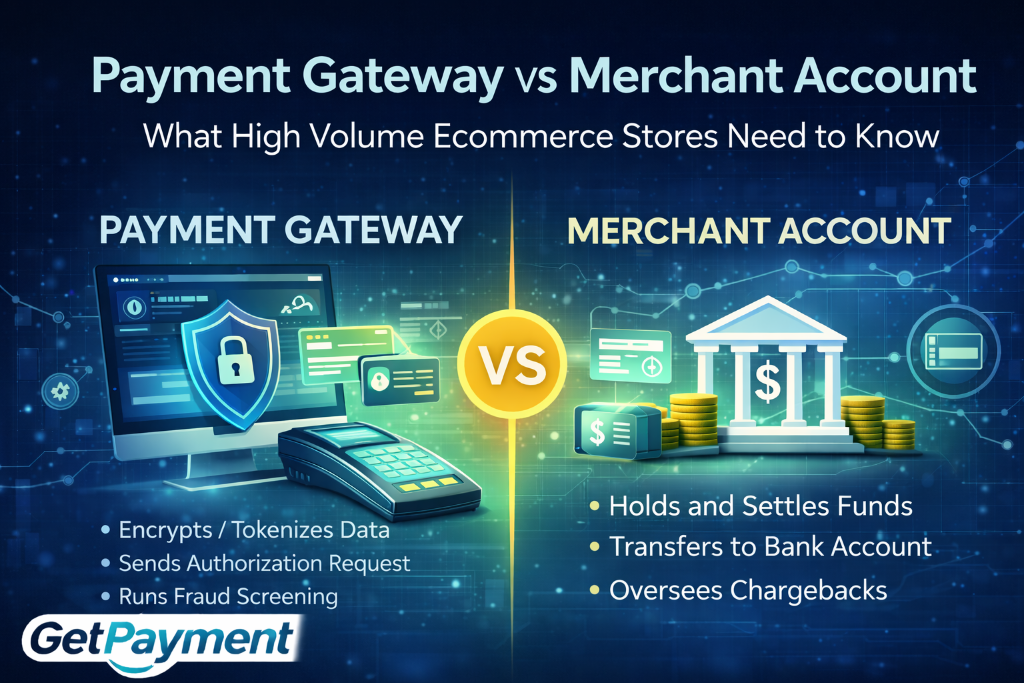
A payment gateway is the technology that securely sends a customer's payment information from your website or checkout page to the payment processor for approval.
In simple terms, it acts as the connection between your customer, your checkout, and the financial institutions involved in authorizing the payment.
A payment gateway usually handles:
- Secure encryption of card data
- Transmission of payment details
- Real-time approval or decline responses
- Integration with websites, funnels, carts, and subscription systems
Popular examples include Stripe, PayPal, and Authorize.net.
For small businesses, a gateway can seem like the only tool needed. But for scaling merchants, that is rarely enough. Many gateway-first platforms are built for convenience, not resilience. As volume grows, businesses can run into issues like account reviews, rolling reserves, frozen funds, or sudden terminations.
What Is a Merchant Account?
A merchant account is a specialized business account that allows your company to accept card payments and receive settled funds from approved transactions.
Unlike a simple all-in-one platform, a merchant account is typically underwritten based on your business model, industry, processing history, and risk profile. That means it is designed with more structure and more stability.
A merchant account generally handles:
- Receiving authorized card transactions
- Holding funds before settlement
- Connecting your business to acquiring banks
- Supporting higher-volume payment processing
- Providing a stronger foundation for long-term scale
For growing businesses, this matters because scaling usually requires more than convenience. It requires reliability, flexibility, and infrastructure that can support real transaction volume without collapsing under risk controls.
Payment Gateways vs Merchant Accounts: The Core Difference
The easiest way to understand the difference is this:
A payment gateway helps move payment information.
A merchant account helps process and settle the money.
The gateway is the technology layer customers interact with during checkout. The merchant account is the financial layer that makes the actual card acceptance possible behind the scenes.
This distinction becomes far more important when a business scales. Many business owners think they only need a gateway because that is all they see on the frontend. But serious payment infrastructure depends on what is happening in the backend as well.
Why Scaling Businesses Need More Than a Simple Processor
At low volume, many merchants can get away with using a simple payment platform. But once a business starts processing larger amounts, running subscriptions, entering higher-risk industries, or scaling aggressively with paid traffic, the risk profile changes.
That is often when businesses discover the weaknesses of relying on one aggregator.
Common problems include:
- Sudden account shutdowns
- Funds being held for long periods
- Increased chargeback scrutiny
- Limited ability to explain or negotiate underwriting decisions
- Reduced control over payment routing and redundancy
These issues are not small inconveniences. They can interrupt cash flow, stall marketing, damage fulfillment, and create trust issues with customers.
It Is Not Gateway vs Merchant Account — It Is Gateway Plus Merchant Account
One of the biggest misconceptions in payments is thinking you need to choose one or the other.
In reality, scaling businesses often need both.
The payment gateway provides the customer-facing transaction technology. The merchant account provides the financial infrastructure that supports approval, settlement, and ongoing processing stability.
When these two pieces are set up properly together, businesses gain:
- Better control over their payment stack
- More stable processing infrastructure
- Greater flexibility as they grow
- Protection against depending on a single provider
- The ability to build redundancy into their checkout systems
That is what makes the difference between a business that can scale safely and one that remains vulnerable to disruption.
The Biggest Mistake Merchants Make When Growing
The biggest mistake is staying with a single all-in-one processor for too long.
Platforms like Stripe can be useful early on because they are fast to set up and easy to integrate. But the same simplicity that makes them attractive at the beginning can become a weakness later.
As your business scales, your exposure rises. Larger volume, more chargebacks, continuity billing, international traffic, high-ticket offers, or industries with elevated scrutiny can all increase the likelihood of restrictions.
When one processor controls everything and that relationship breaks, the consequences can be immediate:
- Revenue stops
- Funds get delayed
- Advertising becomes harder to sustain
- Customer service issues increase
- Operations become unstable
That is why serious merchants move from convenience-based setups to infrastructure-based setups.
Who Should Strongly Consider a Merchant Account?
A merchant account becomes especially important if your business falls into one or more of these categories:
- You process significant monthly volume
- You sell in a higher-risk vertical
- You run a subscription or continuity model
- You have already experienced issues with Stripe or PayPal
- You rely heavily on paid traffic and need uptime
- You want more control over approvals and settlement stability
These businesses usually need more than a basic plug-and-play solution. They need a payment stack designed to support growth instead of react against it.
Why Risk Level Changes Everything
Not all businesses are treated the same by processors.
Low-risk businesses may have more options and face fewer restrictions. But high-risk or medium-risk merchants are often scrutinized much more closely, especially if they operate in industries known for higher chargeback rates, regulatory sensitivity, or aggressive advertising models.
Examples often include:
- Supplements
- Nutra
- Info products
- Coaching and education offers
- Subscription businesses
- Crypto-related offers
- Forex and trading
- Other high-risk digital or continuity models
These businesses are often poor fits for simple aggregators. They typically need specialized merchant accounts, stronger underwriting alignment, and often more than one processing relationship to ensure stability.
Why Payment Redundancy Matters for Scale
One of the smartest things a scaling business can do is create redundancy in its payment stack.
Redundancy means you are not dependent on a single processor, a single bank relationship, or a single point of failure. If one channel is disrupted, your business can continue operating through another.
This matters because payments are not just a backend function. They are the engine of the business. If that engine stops, growth stops with it.
A strong setup can include:
- A reliable gateway
- A dedicated merchant account
- Backup processing relationships
- Risk-aware routing strategy
- A structure built around business model fit
For scaling merchants, this is often the difference between surviving processor issues and being crippled by them.
How GetPayment Helps Businesses Scale Safely
GetPayment helps merchants build payment infrastructure that is made for stability, not just convenience.
We work with businesses that need:
- Merchant account approvals
- High-risk payment solutions
- Backup processing options
- More reliable long-term payment infrastructure
- Protection against shutdown risk as they scale
The goal is not just to get you processing. The goal is to help you build a structure that supports growth, protects revenue, and reduces the chance of payment disruption.
Final Thoughts
If your business is serious about scaling, your payment setup needs to grow with you.
A payment gateway plays an important role, but it is only one part of the picture. A merchant account provides the deeper infrastructure needed to support reliable, long-term processing.
The most successful scaling businesses do not build their payment operations around convenience alone. They build around stability, redundancy, and control.
If you want to reduce risk, improve resilience, and support aggressive growth, understanding the difference between payment gateways and merchant accounts is essential.
Ready to Build a More Stable Payment Setup?
If your business has been shut down by Stripe, worried about payment stability, or preparing to scale harder, GetPayment can help you build a stronger setup.
Apply with GetPayment to secure a merchant account structure built for growth, stability, and long-term processing success.
 Understand the difference between payment gateways and merchant accounts for scaling businesses. Learn why growing merchants need more than a simple processor to build stable, resilient payment infrastructure.