Introduction: The Hidden Revenue Loss in Ecommerce Payments
Most ecommerce businesses focus on ads, funnels, and conversion rates.
But one of the biggest leaks in revenue happens after the customer clicks "buy."
Payments get declined.
And every declined transaction is lost revenue.
What many businesses do not realize is that a significant portion of these declines can be recovered with better payment infrastructure.
This is where network tokenisation for ecommerce authorisation rates becomes a powerful advantage. It helps increase approvals, reduce unnecessary declines, and create a more resilient payment system.
What Is Network Tokenisation?
Network tokenisation replaces a customer's actual card number with a secure, network-issued token.
Instead of storing or transmitting raw card data, the system uses a token provided directly by card networks like Visa or Mastercard.
This token is:
- Unique to the merchant and transaction context
- Secure and encrypted
- Updatable without requiring the customer to re-enter details
Unlike basic tokenisation from gateways, network tokenisation is managed at the card network level, making it more trusted and more effective.
Why Traditional Card Payments Fail More Often
Standard card processing relies on static card details.
These details can become outdated or trigger declines due to:
- Expired cards
- Reissued cards
- Fraud suspicion
- Issuer risk models
- Inconsistent transaction data
When this happens, transactions fail even if the customer is legitimate and has sufficient funds.
At scale, these failures add up quickly.
How Network Tokenisation Increases Authorisation Rates
Network tokenisation improves how transactions are recognized and approved by issuing banks.
Because the token is issued by the card network, it carries additional trust signals.
This leads to:
- Higher approval confidence from issuing banks
- Reduced false declines
- Better handling of recurring and stored credentials
- Improved transaction consistency
In many cases, transactions using network tokens are treated as lower risk compared to raw card data.
That difference directly impacts approval rates.
Automatic Card Updates and Subscription Stability
One of the biggest advantages of network tokenisation is automatic card updating.
When a customer's card expires or is replaced, the token can be updated behind the scenes without interrupting billing.
This is especially important for:
- Subscription businesses
- Continuity offers
- Membership platforms
Instead of failed payments and churn, transactions continue smoothly.
This results in:
- Higher retention
- Fewer failed rebills
- More predictable revenue
Reduced Fraud and Better Security
Security plays a major role in payment approvals.
Network tokenisation reduces fraud risk by removing sensitive card data from the transaction flow.
Because the token is:
- Merchant-specific
- Network-controlled
- Useless if intercepted
It significantly lowers the risk of data breaches and misuse.
Lower fraud risk leads to:
- Fewer declines from issuer suspicion
- Lower chargeback rates
- Better long-term processor relationships
Security and performance are directly linked in payments.
Network tokenisation is also the foundation of many modern payment methods.
Digital wallets like Apple Pay and Google Pay rely heavily on tokenised transactions.
These payments typically see:
- Higher approval rates
- Faster checkout experiences
- Lower fraud rates
For ecommerce businesses, supporting tokenised payments improves both user experience and backend performance.
Why High-Volume Ecommerce Businesses Need Tokenisation
At small scale, payment inefficiencies may go unnoticed.
At high volume, they become extremely expensive.
If your business processes large numbers of transactions, even a small increase in approval rates can result in significant revenue gains.
Network tokenisation becomes especially valuable if you:
- Run subscription or recurring billing models
- Sell high-ticket products
- Operate globally
- Experience high decline rates
- Want to reduce churn from failed payments
For these businesses, tokenisation is not just a security feature. It is a revenue optimization tool.
The Difference Between Basic Tokenisation and Network Tokenisation
Many businesses assume they are already using tokenisation through their gateway.
But not all tokenisation is the same.
Basic gateway tokenisation simply replaces card data within that specific system.
Network tokenisation, on the other hand:
- Is issued by card networks
- Works across different processors
- Carries stronger trust signals
- Updates automatically when card details change
This makes it significantly more powerful for improving authorisation rates.
Combining Tokenisation with Smart Payment Infrastructure
Network tokenisation becomes even more effective when combined with a strong payment setup.
When used alongside:
- Multiple acquirers
- Smart routing systems
- Payment orchestration
It helps create a fully optimized payment flow.
This combination allows businesses to:
- Maximize approvals
- Reduce declines
- Improve customer experience
- Scale without payment friction
Tokenisation is not a standalone solution. It is part of a larger payment strategy.
Common Mistakes Ecommerce Businesses Make
Despite its benefits, many businesses fail to implement tokenisation correctly.
Common mistakes include:
- Relying only on basic gateway tokenisation
- Not enabling network tokenisation with providers
- Ignoring recurring billing optimization
- Failing to integrate tokenisation into routing strategies
- Treating payments as static instead of dynamic systems
These mistakes leave revenue on the table.
How GetPayment Helps You Increase Authorisation Rates
At GetPayment, we help ecommerce businesses build payment systems designed for performance.
We help you:
- Implement network tokenisation
- Connect with the right acquiring partners
- Optimize payment routing
- Reduce decline rates
- Improve recurring billing success
- Build infrastructure that scales with your business
Our goal is not just to get transactions processed, but to maximize how many get approved.
Final Thoughts: Small Gains in Approvals Drive Massive Revenue
In ecommerce, growth is often driven by small optimizations at scale.
Improving your authorisation rate by even a few percentage points can result in:
- Significant revenue increases
- Better return on ad spend
- Higher customer lifetime value
Network tokenisation is one of the most effective ways to achieve this.
It improves trust, reduces friction, and strengthens your entire payment system.
Ready to Increase Your Approval Rates?
If you want to increase approval rates, reduce failed payments, and build a stronger payment infrastructure, GetPayment can help.
Apply today to implement network tokenisation and start capturing more of the revenue you are already generating.
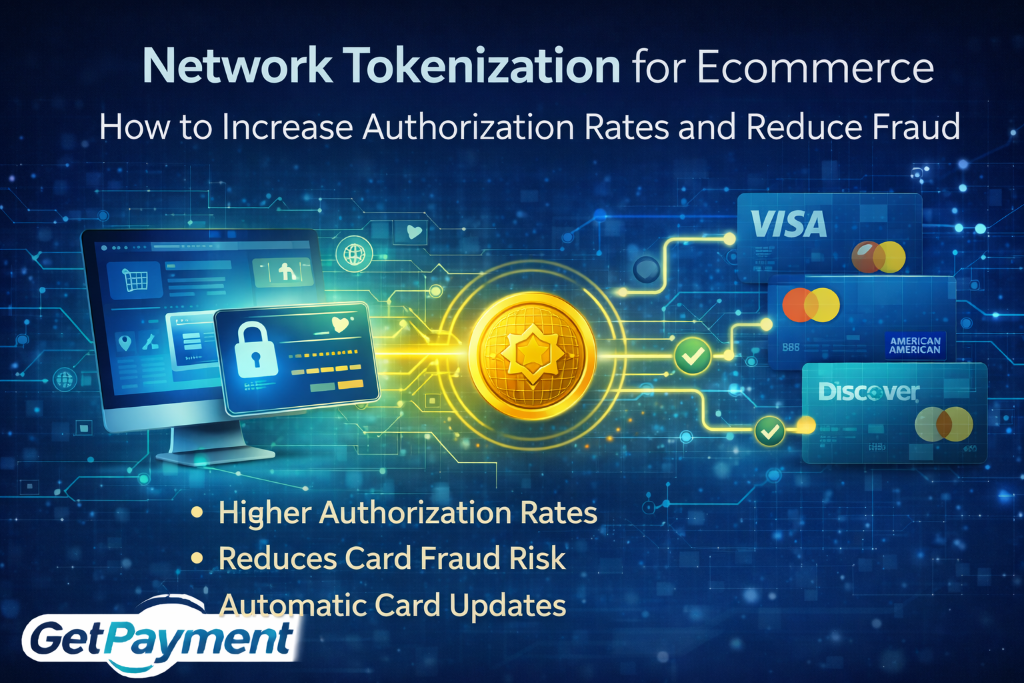 Learn how network tokenisation improves ecommerce authorisation rates, reduces declines, and boosts revenue for scaling online businesses.