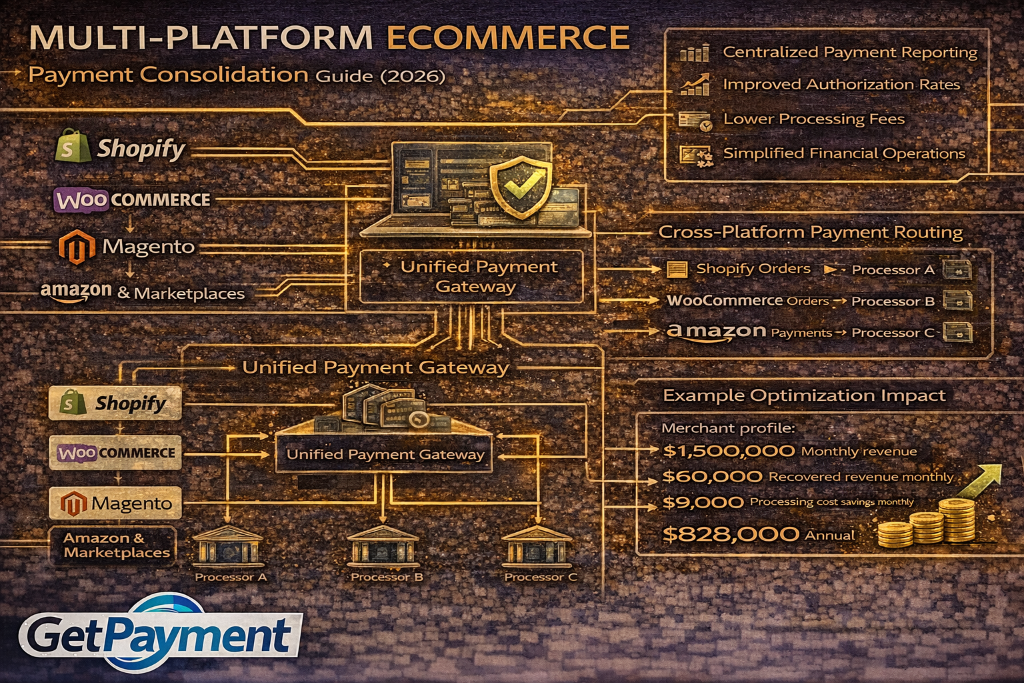
 Learn how to consolidate payments across multiple ecommerce platforms to reduce costs, improve approval rates, and scale efficiently.
Need Payment Processing?
✓ Stripe shutdown?
✓ High-risk industry?
✓ Declined payments?
Get approved today.
Apply NowKey Takeaways
As ecommerce businesses scale, they often expand across multiple platforms.
* Shopify for one brand * WooCommerce for another * Magento for enterprise operations * Custom or headless builds for specific markets
- ✓Shopify for one brand
- ✓WooCommerce for another
- ✓Magento for enterprise operations
- ✓Custom or headless builds for specific markets
- ✓Different payment gateways
Introduction: The Hidden Complexity of Multi-Platform Ecommerce
As ecommerce businesses scale, they often expand across multiple platforms.
You might be running:
- Shopify for one brand
- WooCommerce for another
- Magento for enterprise operations
- Custom or headless builds for specific markets
This creates flexibility and growth opportunities.
But it also creates a major problem.
Fragmented payments.
Each platform may have:
- Different payment gateways
- Separate processors
- Inconsistent fraud systems
- Disconnected reporting
This leads to inefficiencies, higher costs, and lost revenue.
This is why multi-platform ecommerce payment consolidation is critical for high-volume merchants.
What Is Payment Consolidation?
Payment consolidation is the process of unifying your payment infrastructure across multiple platforms into a single, optimized system.
Instead of managing separate setups, you:
- Centralize payment orchestration
- Connect multiple platforms to shared infrastructure
- Standardize routing and processing logic
- Consolidate reporting and analytics
This creates a more efficient and scalable system.
Why Multi-Platform Businesses Struggle with Payments
When you operate across platforms, payments often evolve independently.
Each platform may have been set up at a different time with different providers.
This leads to:
- Inconsistent approval rates
- Higher processing costs
- Duplicate fees
- Limited visibility into performance
Without consolidation, these inefficiencies compound as you scale.
The Cost of Fragmented Payment Systems
Fragmentation is expensive.
It leads to:
- Higher effective processing rates
- Missed optimization opportunities
- Increased operational complexity
- Poor negotiation leverage
You may also struggle to identify issues because data is spread across systems.
The Goal of Payment Consolidation
The goal is not to eliminate flexibility.
It is to create a unified system that:
- Optimizes performance
- Reduces costs
- Improves visibility
- Scales efficiently
You still maintain platform diversity, but your payment infrastructure becomes centralized.
Centralizing Payment Orchestration
Payment orchestration is the foundation of consolidation.
It acts as a central control layer across all platforms.
With orchestration, you can:
- Manage multiple gateways and acquirers
- Apply consistent routing logic
- Control transaction flows
- Optimize approvals globally
This removes the need for separate configurations on each platform.
Unifying Multiple Gateways and Providers
Instead of using different gateways for each platform, consolidation allows you to unify them.
You can:
- Connect all platforms to a shared gateway or orchestration layer
- Standardize integrations
- Reduce redundancy
This simplifies your system and reduces operational overhead.
Multi-Acquirer Strategy Across Platforms
One of the biggest advantages of consolidation is applying a multi-acquirer strategy globally.
Instead of each platform using its own processor, you can:
- Share acquiring partners across platforms
- Optimize routing centrally
- Improve approval rates across all brands
This creates consistency and efficiency.
Smart Routing Across All Channels
With a consolidated system, routing decisions are no longer platform-specific.
You can:
- Route transactions based on geography
- Optimize based on approval rates
- Adjust dynamically across all platforms
This ensures every transaction is processed in the most efficient way.
Consolidated Reporting and Data Visibility
One of the biggest challenges in multi-platform ecommerce is data fragmentation.
Payment consolidation allows you to:
- Centralize reporting
- Track performance across all platforms
- Analyze approval rates and decline reasons
- Identify trends and inefficiencies
Better data leads to better decisions.
Reducing Payment Processing Costs
Consolidation can significantly reduce costs.
You can:
- Eliminate duplicate fees
- Negotiate better rates with higher volume
- Optimize interchange performance
- Reduce cross-border inefficiencies
At scale, these savings are substantial.
Improving Approval Rates Across Platforms
Fragmented systems often lead to inconsistent approval rates.
By consolidating, you can:
- Apply optimized routing globally
- Use the best-performing acquirers
- Improve transaction data quality
This increases revenue without increasing traffic.
Standardizing Fraud Prevention
Different platforms often use different fraud systems.
This creates inconsistency and inefficiency.
Consolidation allows you to:
- Apply consistent fraud rules
- Use centralized risk scoring
- Balance fraud and conversion across all platforms
This improves both security and performance.
Managing Cross-Border Transactions Efficiently
If you operate globally, consolidation is even more important.
You can:
- Use local acquiring across platforms
- Optimize currency handling
- Reduce cross-border fees
This improves both margins and customer experience.
Subscription and Recurring Payment Optimization
If you run subscription models across platforms, consolidation is critical.
You can:
- Standardize billing logic
- Improve retry strategies
- Use account updater services
- Reduce churn from failed payments
This leads to more stable recurring revenue.
Redundancy and Risk Management
A consolidated system allows for better risk management.
You can:
- Implement failover across platforms
- Maintain processing during outages
- Reduce dependency on single providers
This ensures business continuity.
Integration Challenges and How to Overcome Them
Consolidation requires careful planning.
Common challenges include:
- Platform compatibility
- API integration complexity
- Data synchronization
- Migration risks
These can be managed with the right architecture and strategy.
Headless and API-Driven Approaches
Many businesses use headless or API-driven systems to enable consolidation.
This allows:
- Flexible integrations
- Centralized control
- Scalable infrastructure
API-first design is key for modern payment systems.
Common Mistakes in Payment Consolidation
Many businesses struggle with consolidation due to avoidable mistakes.
These include:
- Trying to unify everything too quickly
- Choosing the wrong orchestration layer
- Ignoring platform-specific requirements
- Not planning for scale
- Failing to monitor performance
A strategic approach is essential.
The Financial Impact of Consolidation
When done correctly, consolidation can lead to:
- Lower processing costs
- Higher approval rates
- Improved operational efficiency
- Better scalability
At high volume, these improvements can be transformative.
How GetPayment Helps You Consolidate Payments
At GetPayment, we help ecommerce businesses unify their payment systems across platforms.
We help you:
- Design consolidated payment architecture
- Implement orchestration layers
- Optimize routing and approvals
- Reduce costs and inefficiencies
- Build scalable systems
Our goal is to turn fragmented systems into high-performance engines.
Final Thoughts: Simplicity at Scale Is a Competitive Advantage
As your business grows, complexity increases.
But complexity should not reduce performance.
Payment consolidation allows you to:
- Simplify operations
- Optimize performance
- Scale efficiently
The businesses that win are the ones that unify their systems while maintaining flexibility.
Ready to Consolidate Your Payment Systems?
If you want to consolidate your payment systems, reduce costs, and improve performance across all your ecommerce platforms, GetPayment can help.
Apply today to build a unified payment infrastructure designed for scale.
FAQ: Multi-Platform Payment Consolidation
What is payment consolidation?
Payment consolidation is the process of unifying payment systems across multiple platforms into a single, optimized infrastructure.
Why is payment consolidation important?
It reduces costs, improves approval rates, and simplifies operations for multi-platform ecommerce businesses.
Can consolidation improve approval rates?
Yes. By optimizing routing and using the best-performing acquirers, approval rates can increase significantly.
Does consolidation reduce costs?
Yes. It eliminates duplicate fees, improves negotiation leverage, and optimizes processing.
Is payment consolidation complex?
It can be, but with the right strategy and infrastructure, it becomes manageable and highly beneficial.
What is payment orchestration in consolidation?
It is a central layer that manages routing, providers, and transaction logic across multiple platforms.
Can small businesses benefit from consolidation?
It is most impactful for high-volume businesses, but growing businesses can also benefit as they scale.
Tags

Jane Harold
Head of Payment Strategy
GetPayment Inc
Jane Harold is a payment strategy expert with 12+ years of experience in high-volume ecommerce payments, merchant account management, and checkout optimization. She has helped hundreds of US ecommerce brands improve authorization rates, reduce processing costs, and scale payment infrastructure.
Areas of Expertise
Payment Strategy Expert
12+ years in industry
Certified Payment Specialist
PCI DSS Level 1 compliance
Merchant Account Advisor
500+ merchants advised
Industry Speaker
Ecommerce & payment conferences
Get Expert Advice
Have questions about payment processing? Reach out to Jane directly.
Years Experience
Merchants Helped
Bank Partners
Satisfaction Rate
Recover Revenue From Payment Declines
GetPayment helps ecommerce merchants increase approval rates with smart routing and high-risk-friendly processors.
High-risk friendly
Multiple processors
Global coverage
Get Your Free Payment Fee Audit
See exactly how much you're overpaying in processing fees. Our experts analyze your statement and show you potential savings.
Request Free AuditLearn more in our Payment Infrastructure & Platforms Guide
Explore the complete guide for this topic with deeper insights and strategies.
View Guide →Related Articles
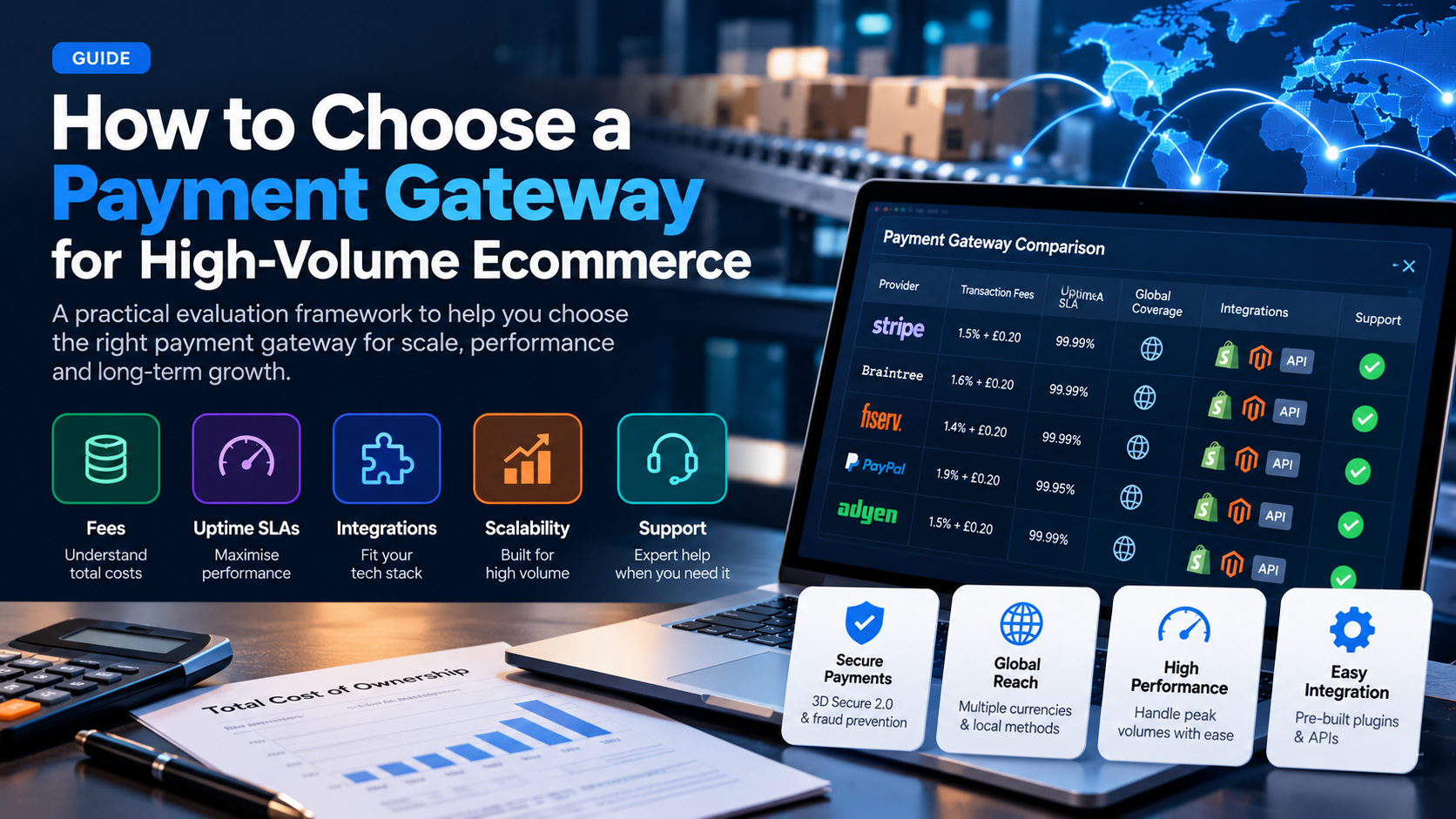
How to Choose a Payment Gateway for High-Volume Ecommerce (2026 Guide)
A practical framework for evaluating payment gateways when you process $50k+ per month: fees, uptime, integrations, scalability, and support.
Read More →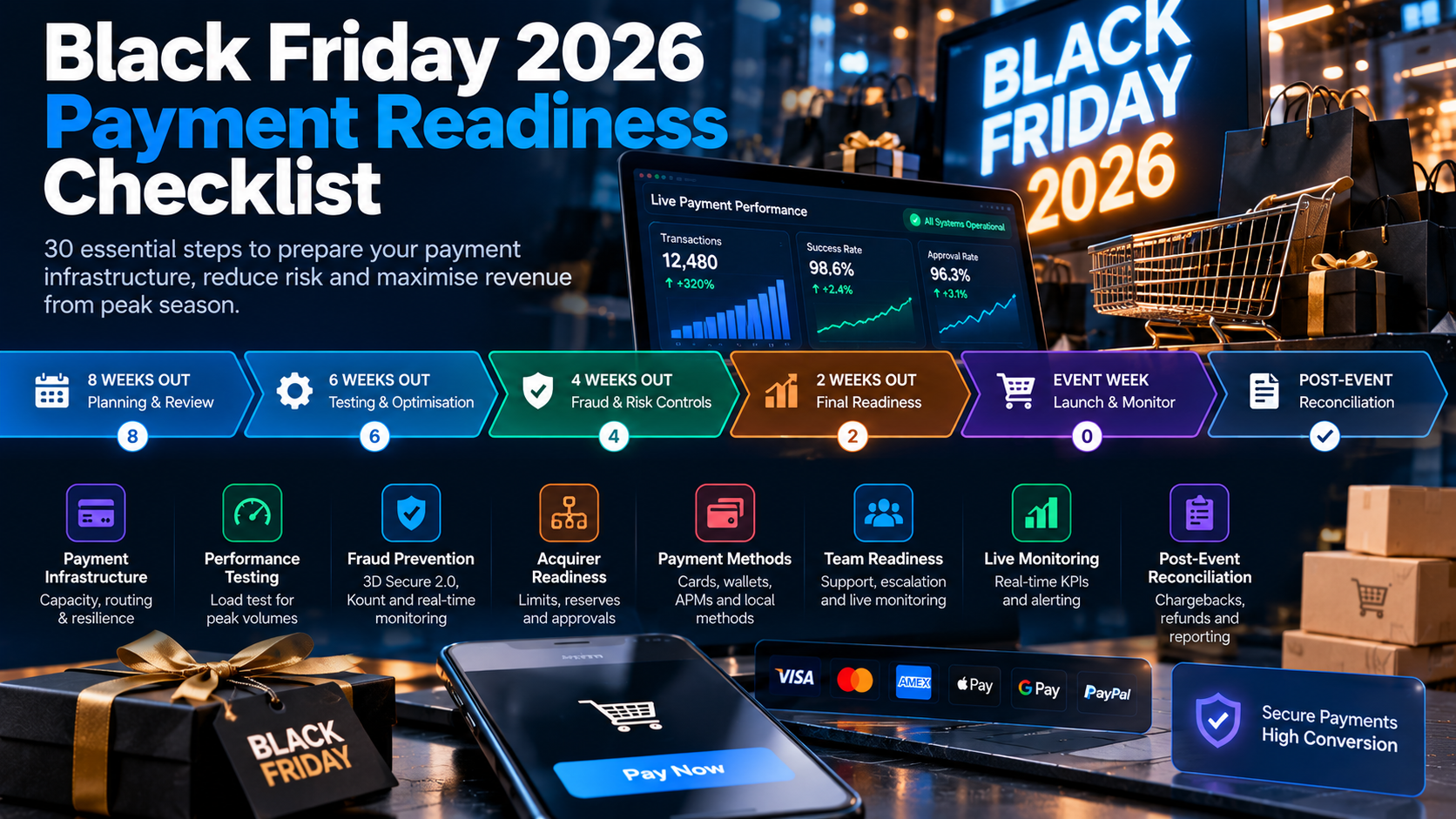
Black Friday 2026 Payment Readiness Checklist: 30 Steps to Prepare Your Checkout for Peak Traffic
Black Friday is the highest-traffic, highest-revenue day of the year. A single checkout failure costs thousands per minute. This 30-step checklist ensures your payments are ready.
Read More →