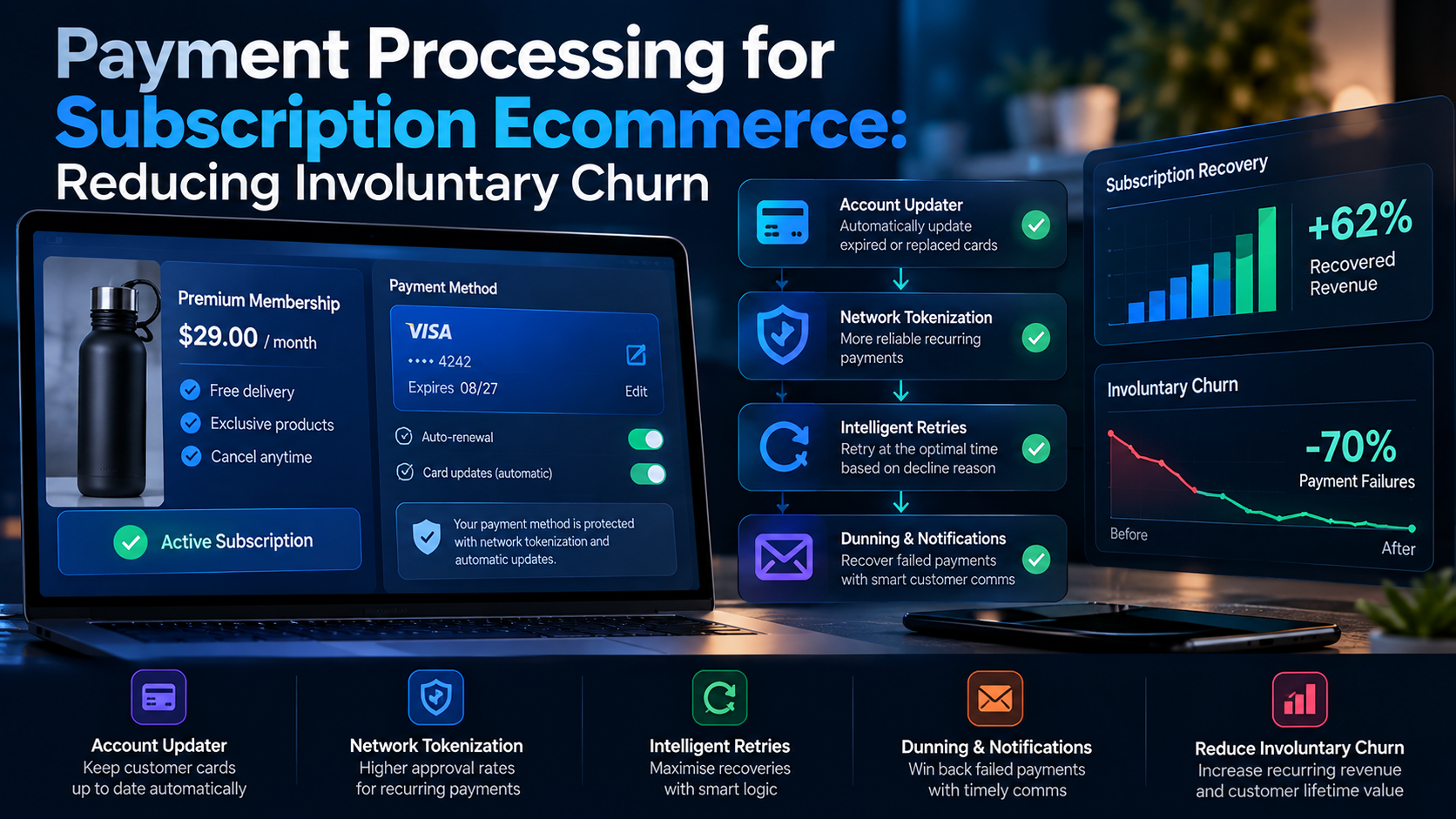
 How to reduce involuntary churn in subscription ecommerce: account updater, intelligent retries, network tokenization, and dunning best practices for 2026.
Need Payment Processing?
✓ Stripe shutdown?
✓ High-risk industry?
✓ Declined payments?
Get approved today.
Apply NowKey Takeaways
- Involuntary churn is the silent revenue killer: 20-40% of subscription cancellations are caused by failed payments, not customer choice. Recovering even half of these transforms your bottom line. - Account updater is your first line of defense: Automatic card updates recover 30-50% of failed recurring payments before you ever send a dunning email. - Smart retry logic beats brute force: Intelligent retry timing (3-5 attempts over 10-14 days) recovers 50-70% of initially declined recurring transactions. - Dunning communication matters: Well-timed, customer-friendly retry emails recover 10-15% of remaining failures. Aggressive or confusing messages lose customers permanently. - Network tokenization is the 2026 standard: Network-issued tokens update automatically when cards change, reducing involuntary churn by 15-25% compared to raw card storage.
Involuntary churn happens when a subscription is cancelled because a recurring payment fails, even though the customer wanted to keep the subscription. Unlike voluntary churn (where a customer chooses to cancel), involuntary churn is a payment failure problem, not a customer satisfaction problem.
- ✓Involuntary churn is the silent revenue killer: 20-40% of subscription cancellations are caused by failed payments, not customer choice. Recovering even half of these transforms your bottom line.
- ✓Account updater is your first line of defense: Automatic card updates recover 30-50% of failed recurring payments before you ever send a dunning email.
- ✓Smart retry logic beats brute force: Intelligent retry timing (3-5 attempts over 10-14 days) recovers 50-70% of initially declined recurring transactions.
- ✓Dunning communication matters: Well-timed, customer-friendly retry emails recover 10-15% of remaining failures. Aggressive or confusing messages lose customers permanently.
- ✓Network tokenization is the 2026 standard: Network-issued tokens update automatically when cards change, reducing involuntary churn by 15-25% compared to raw card storage.
TL;DR — Key Takeaways
- Involuntary churn is the silent revenue killer: 20-40% of subscription cancellations are caused by failed payments, not customer choice. Recovering even half of these transforms your bottom line.
- Account updater is your first line of defense: Automatic card updates recover 30-50% of failed recurring payments before you ever send a dunning email.
- Smart retry logic beats brute force: Intelligent retry timing (3-5 attempts over 10-14 days) recovers 50-70% of initially declined recurring transactions.
- Dunning communication matters: Well-timed, customer-friendly retry emails recover 10-15% of remaining failures. Aggressive or confusing messages lose customers permanently.
- Network tokenization is the 2026 standard: Network-issued tokens update automatically when cards change, reducing involuntary churn by 15-25% compared to raw card storage.
What Is Involuntary Churn?
Involuntary churn happens when a subscription is cancelled because a recurring payment fails, even though the customer wanted to keep the subscription. Unlike voluntary churn (where a customer chooses to cancel), involuntary churn is a payment failure problem, not a customer satisfaction problem.
The numbers are sobering:
- 20-40% of subscription cancellations are involuntary
- The average subscription business loses 9-15% of monthly revenue to failed payments
- 1 in 3 failed payments is caused by an expired or reissued card
- Only 30% of customers proactively update their card after a failure
This means a $100k/month subscription business may be losing $9,000 to $15,000 every month to a problem that is largely fixable.
Why Payments Fail on Recurring Billing
Card-related failures (60-70% of all failures):
- Expired cards
- Lost or stolen card replacements
- Card upgrades (e.g., Visa to Visa Signature)
- Insufficient funds at billing time
- Card blocked by issuer fraud detection
Processor-related failures (15-20%):
- Gateway timeout or error
- Incorrect billing descriptor causing customer confusion
- Processor risk flags triggered by unusual activity
Customer-related failures (10-15%):
- Changed banks without updating payment info
- Disputed a legitimate charge (friendly fraud)
- Closed the account
Strategy 1: Account Updater Services
Account updater is a service from Visa, Mastercard, and Discover that automatically checks whether a stored card has been updated and provides the new details. Your processor queries the card networks and updates your vaulted tokens.
Impact: Account updater typically recovers 30-50% of failed recurring payments before you ever attempt a retry. It is the single highest-ROI tool for reducing involuntary churn.
How to enable it: Ask your payment processor if account updater is included. Most modern processors support it, but it may require activation. There is usually a small per-update fee (typically $0.05 to $0.25), which is trivial compared to the recovered revenue.
Strategy 2: Intelligent Retry Logic
When a recurring payment fails, do not give up. Most failures are temporary — insufficient funds, issuer timeout, or a fraud block that clears.
Best practices for retry scheduling:
- Attempt 1: Original billing date
- Attempt 2: Day 3 (retry after a weekend or payday)
- Attempt 3: Day 5 (different day of week, different issuer load)
- Attempt 4: Day 8 (longer gap)
- Attempt 5: Day 14 (final attempt before suspension)
Why timing matters: Issuer approval rates vary by day of week, time of day, and even season. Spreading retries across different days and times increases the chance of hitting a window when the issuer approves.
Impact: Intelligent retry recovers 50-70% of initially declined recurring transactions. Combined with account updater, you can recover 70-85% of all involuntary churn.
Strategy 3: Network Tokenization
Network tokenization replaces raw card numbers with network-issued tokens (from Visa, Mastercard, or American Express). These tokens are automatically updated by the card networks when the underlying card changes.
Why this matters for subscriptions: With network tokens, when a customer's card is reissued, the token updates automatically — no account updater query needed, no failed payment, no dunning email. The subscription continues uninterrupted.
Impact: Network tokenization reduces involuntary churn by 15-25% compared to storing raw card numbers. It also improves authorization rates by 1-2% because issuers trust network tokens more than vaulted PANs.
2026 status: Network tokenization is now supported by all major processors and card networks. If your processor does not offer it, you are leaving money on the table.
Strategy 4: Dunning Communication
Dunning is the process of communicating with customers when a payment fails. Done well, it recovers 10-15% of remaining failures. Done poorly, it causes voluntary cancellations.
Best practices:
- Send the first email within 24 hours of failure
- Make it friendly, not accusatory ("We couldn't process your payment" not "Your payment was declined")
- Include a direct link to update payment info
- Offer multiple payment methods (card, ACH, PayPal, digital wallets)
- Send 2-3 emails over 10-14 days before suspending service
- Provide a grace period of at least 7 days before cancellation
What to avoid:
- Threatening language or immediate service suspension
- Requiring customers to log in to update payment info (friction kills recovery)
- Sending all emails on the same day
- Hiding the update link behind navigation
Strategy 5: Payment Method Diversity
Offering multiple payment methods reduces failure rates because customers can switch to a working method when one fails.
For subscription ecommerce:
- Credit/debit cards (primary)
- ACH/bank transfer (lower failure rate, lower cost)
- Digital wallets (Apple Pay, Google Pay)
- Buy now, pay later (for higher-ticket subscriptions)
Impact: Adding ACH as a backup payment method can reduce involuntary churn by 5-10% because bank accounts do not expire and rarely change.
Measuring Your Involuntary Churn
Track these metrics monthly:
- Failed payment rate: Failed recurring charges / total attempted
- Recovery rate: Failed payments recovered / total failed
- Involuntary churn rate: Subscriptions lost to failed payments / total subscribers
- Dunning recovery rate: Customers who updated payment info after dunning / total dunning emails sent
A healthy subscription business keeps involuntary churn under 5% of monthly revenue. If yours is above 10%, the strategies in this guide can recover significant revenue.
The Bottom Line
Involuntary churn is the most fixable revenue leak in subscription ecommerce. Account updater, intelligent retries, network tokenization, and good dunning communication can recover 70-85% of failed payments. For a $100k/month subscription business, that is $6,000 to $12,000 in recovered revenue every month.
Next Steps
- Ask your processor to enable account updater if you have not already
- Audit your retry logic — are you retrying 3-5 times over 10-14 days?
- Ask your processor about network tokenization support
- Review your dunning email sequence for tone and ease of payment update
- Add ACH as a backup payment method if you do not offer it
Tags

Jane Harold
Head of Payment Strategy
GetPayment Inc
Jane Harold is a payment strategy expert with 12+ years of experience in high-volume ecommerce payments, merchant account management, and checkout optimization. She has helped hundreds of US ecommerce brands improve authorization rates, reduce processing costs, and scale payment infrastructure.
Areas of Expertise
Payment Strategy Expert
12+ years in industry
Certified Payment Specialist
PCI DSS Level 1 compliance
Merchant Account Advisor
500+ merchants advised
Industry Speaker
Ecommerce & payment conferences
Get Expert Advice
Have questions about payment processing? Reach out to Jane directly.
Years Experience
Merchants Helped
Bank Partners
Satisfaction Rate
Recover Revenue From Payment Declines
GetPayment helps ecommerce merchants increase approval rates with smart routing and high-risk-friendly processors.
High-risk friendly
Multiple processors
Global coverage
Get Your Free Payment Fee Audit
See exactly how much you're overpaying in processing fees. Our experts analyze your statement and show you potential savings.
Request Free AuditRelated Articles
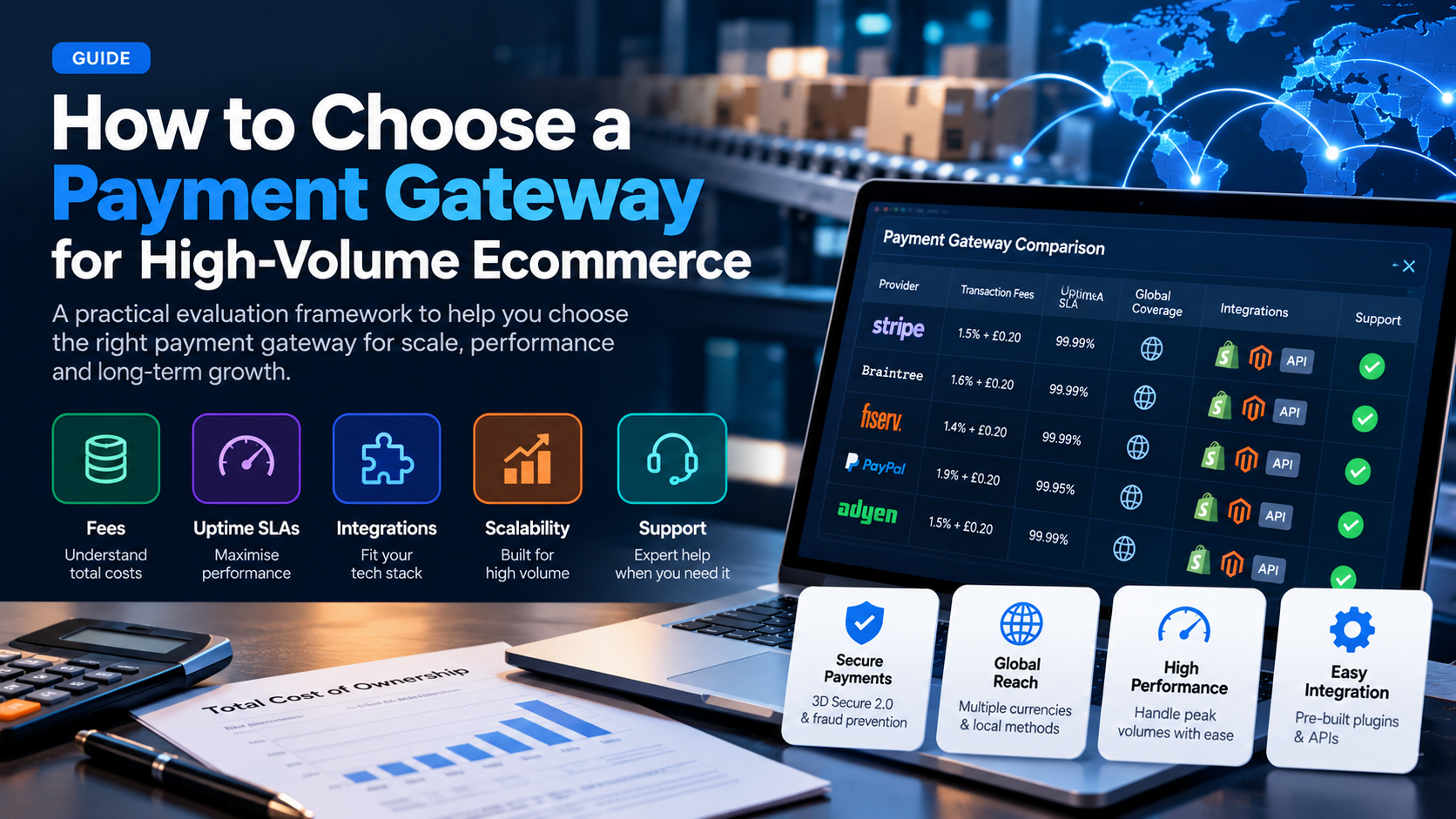
How to Choose a Payment Gateway for High-Volume Ecommerce (2026 Guide)
A practical framework for evaluating payment gateways when you process $50k+ per month: fees, uptime, integrations, scalability, and support.
Read More →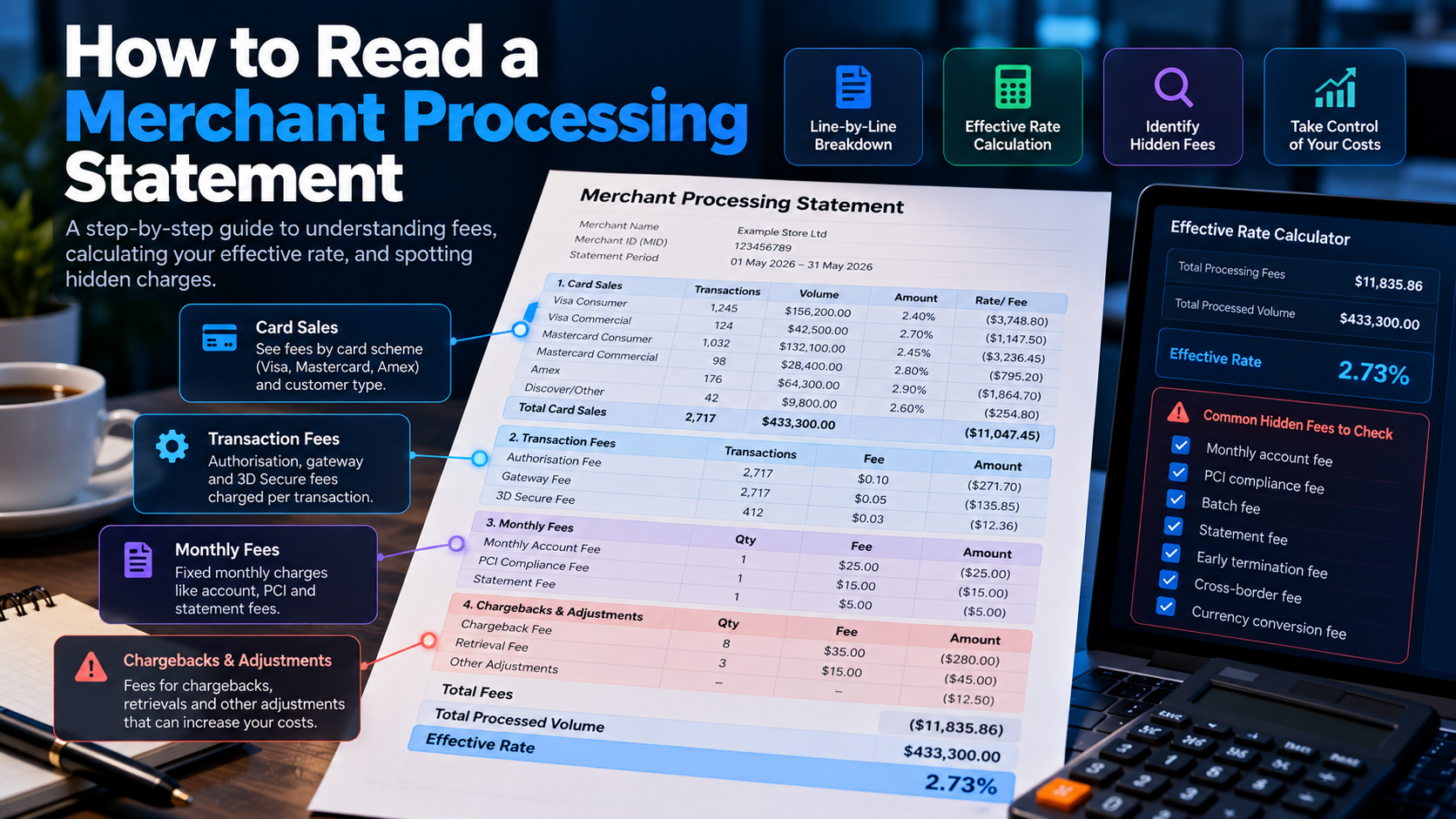
How to Read a Merchant Processing Statement (2026 Guide): Find Hidden Fees and Save Thousands
Merchant statements are deliberately confusing. This guide breaks down every line item, shows you how to calculate your true effective rate, and reveals where processors hide fees.
Read More →