guides
GetPayment vs Stripe high volume ecommerceStripe alternative scaling businessesbest payment processor high volumeimprove approval rates ecommercereduce payment costs Stripe alternative
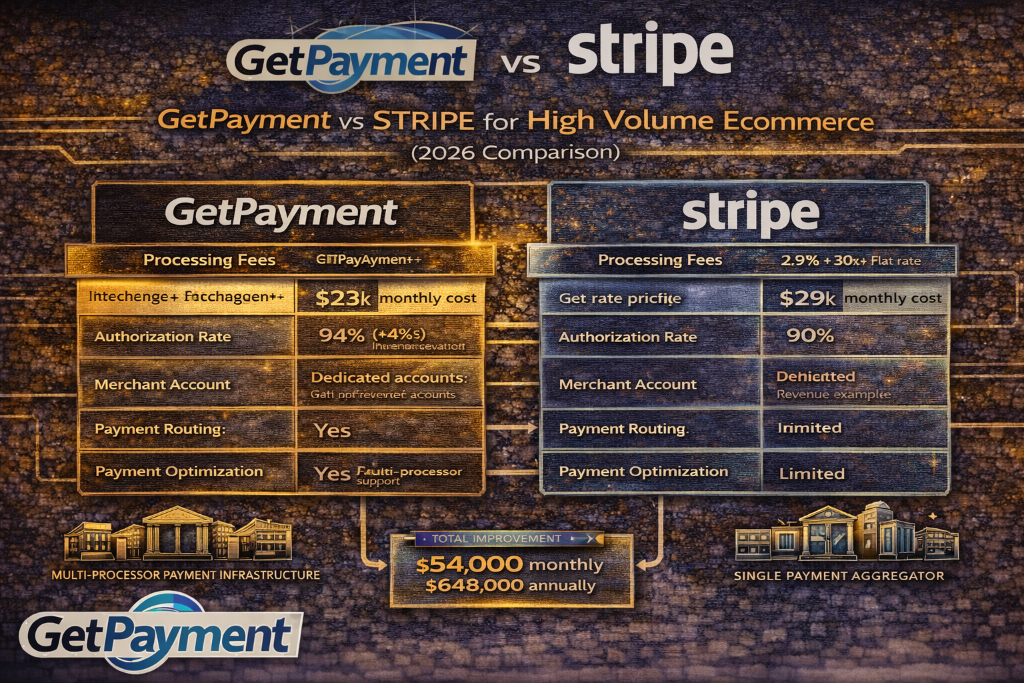 Compare GetPayment vs Stripe for high-volume ecommerce. Learn which solution offers better approvals, lower costs, and scalability.
✓ Stripe shutdown?
✓ High-risk industry?
✓ Declined payments?
Get approved today.
Apply NowStripe is one of the most popular payment processors in the world.
It is easy to set up, developer-friendly, and widely trusted.
Stripe is one of the most popular payment processors in the world.
It is easy to set up, developer-friendly, and widely trusted.
For startups and small ecommerce businesses, it works well.
But as businesses scale, many merchants begin to encounter limitations.
At high volume, payments become more complex.
You need:
This is where the comparison between GetPayment vs Stripe for high-volume ecommerce becomes critical.
Because what works at $50K/month often breaks at $1M+ per month.
Stripe is a full-stack payment processor.
It provides:
Its strength lies in simplicity.
You can get started quickly and manage everything in one place.
However, this simplicity comes with trade-offs.
GetPayment is designed specifically for scaling and high-volume ecommerce businesses.
Instead of being a single processor, it focuses on:
It acts more like a payment performance partner than a single provider.
The biggest difference is structural.
Stripe is a processor.
GetPayment is an optimization layer.
With Stripe, you rely on a single provider to handle everything.
With GetPayment, you build a system using:
This difference becomes critical at scale.
Approval rates are one of the most important metrics in ecommerce.
Even a small improvement can generate significant revenue.
Stripe uses a single acquiring setup.
This limits your ability to optimize approvals.
GetPayment focuses on:
This leads to higher approval rates.
More approvals mean more revenue without increasing traffic.
One of the biggest concerns for high-volume merchants is account stability.
Stripe operates with strict risk controls.
If your business falls into a higher-risk category or scales quickly, you may experience:
GetPayment is designed to handle higher-risk and scaling businesses.
By using multiple acquirers, it reduces dependency on a single provider.
This creates more stability and resilience.
Stripe offers limited flexibility in how payments are processed.
You are largely confined to its ecosystem.
GetPayment allows for:
This flexibility is essential for scaling businesses.
Stripe uses a flat or blended pricing model.
While simple, this often becomes expensive at scale.
You may be paying:
GetPayment focuses on reducing costs by:
At high volume, even small cost reductions have a major impact.
Stripe supports global payments, but performance can vary.
Cross-border transactions often:
GetPayment improves global performance by:
This is critical for international ecommerce businesses.
Stripe provides built-in fraud tools.
These are effective for standard use cases but may be limited for high-risk or complex businesses.
GetPayment focuses on:
This leads to better performance.
Stripe Checkout is easy to use but less customizable.
For high-performance ecommerce, checkout optimization is critical.
GetPayment supports:
This improves conversion rates and revenue.
One of the biggest limitations of Stripe is that it is a single-acquirer system.
GetPayment enables:
This creates a more resilient and efficient system.
Stripe is designed for ease of use, not necessarily for complex scaling needs.
GetPayment is built for:
This makes it more suitable for enterprise-level ecommerce.
Stripe provides standard reporting tools.
However, when you scale, you need deeper insights.
GetPayment focuses on:
Better data leads to better decisions.
Stripe is still a strong option for:
It is a great starting point.
GetPayment is ideal when:
At this stage, optimization becomes more important than simplicity.
Many businesses delay upgrading their payment system.
Common mistakes include:
These mistakes limit growth.
Moving from a basic setup to an optimized system can lead to:
At scale, the impact can be significant.
At GetPayment, we help merchants transition from basic processors to optimized payment systems.
We help you:
Our goal is to turn your payment system into a growth engine.
Stripe offers simplicity.
GetPayment offers performance.
As your business grows, your priorities change.
You need:
The best merchants understand when it is time to evolve.
If you are scaling your ecommerce business and want to improve approval rates, reduce costs, and build a payment system designed for growth, GetPayment can help.
Apply today to move beyond basic processing and unlock your full revenue potential.
Stripe can handle high volume, but it may lack the flexibility and optimization needed for maximum performance at scale.
GetPayment focuses on optimization, using multiple acquirers and routing strategies to improve approvals and reduce costs.
Yes. By optimizing routing and using multiple providers, approval rates can increase significantly.
Stripe may appear cheaper initially, but at scale, optimized systems often reduce overall costs more effectively.
Not within Stripe itself. You would need external systems to achieve multi-acquirer functionality.
When your volume increases, approval rates matter more, or you need greater flexibility and control.
Yes. It is designed to support higher-risk and scaling ecommerce businesses.
Tags

Head of Payment Strategy
GetPayment Inc
Jane Harold is a payment strategy expert with 12+ years of experience in high-volume ecommerce payments, merchant account management, and checkout optimization. She has helped hundreds of US ecommerce brands improve authorization rates, reduce processing costs, and scale payment infrastructure.
Payment Strategy Expert
12+ years in industry
Certified Payment Specialist
PCI DSS Level 1 compliance
Merchant Account Advisor
500+ merchants advised
Industry Speaker
Ecommerce & payment conferences
Have questions about payment processing? Reach out to Jane directly.
Years Experience
Merchants Helped
Bank Partners
Satisfaction Rate
GetPayment helps ecommerce merchants increase approval rates with smart routing and high-risk-friendly processors.
High-risk friendly
Multiple processors
Global coverage
See exactly how much you're overpaying in processing fees. Our experts analyze your statement and show you potential savings.
Request Free AuditExplore the complete guide for this topic with deeper insights and strategies.
View Guide →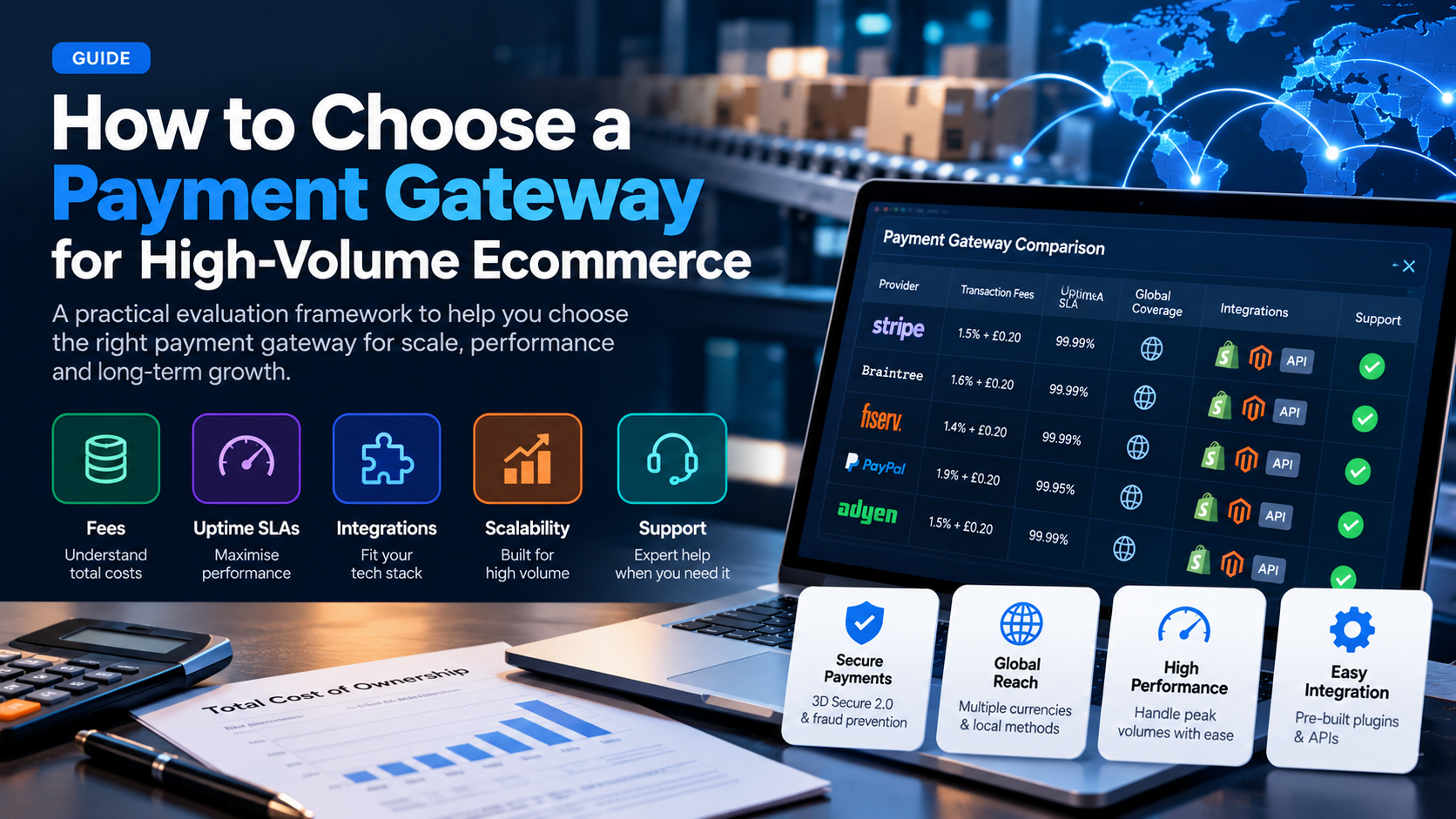
A practical framework for evaluating payment gateways when you process $50k+ per month: fees, uptime, integrations, scalability, and support.
Read More →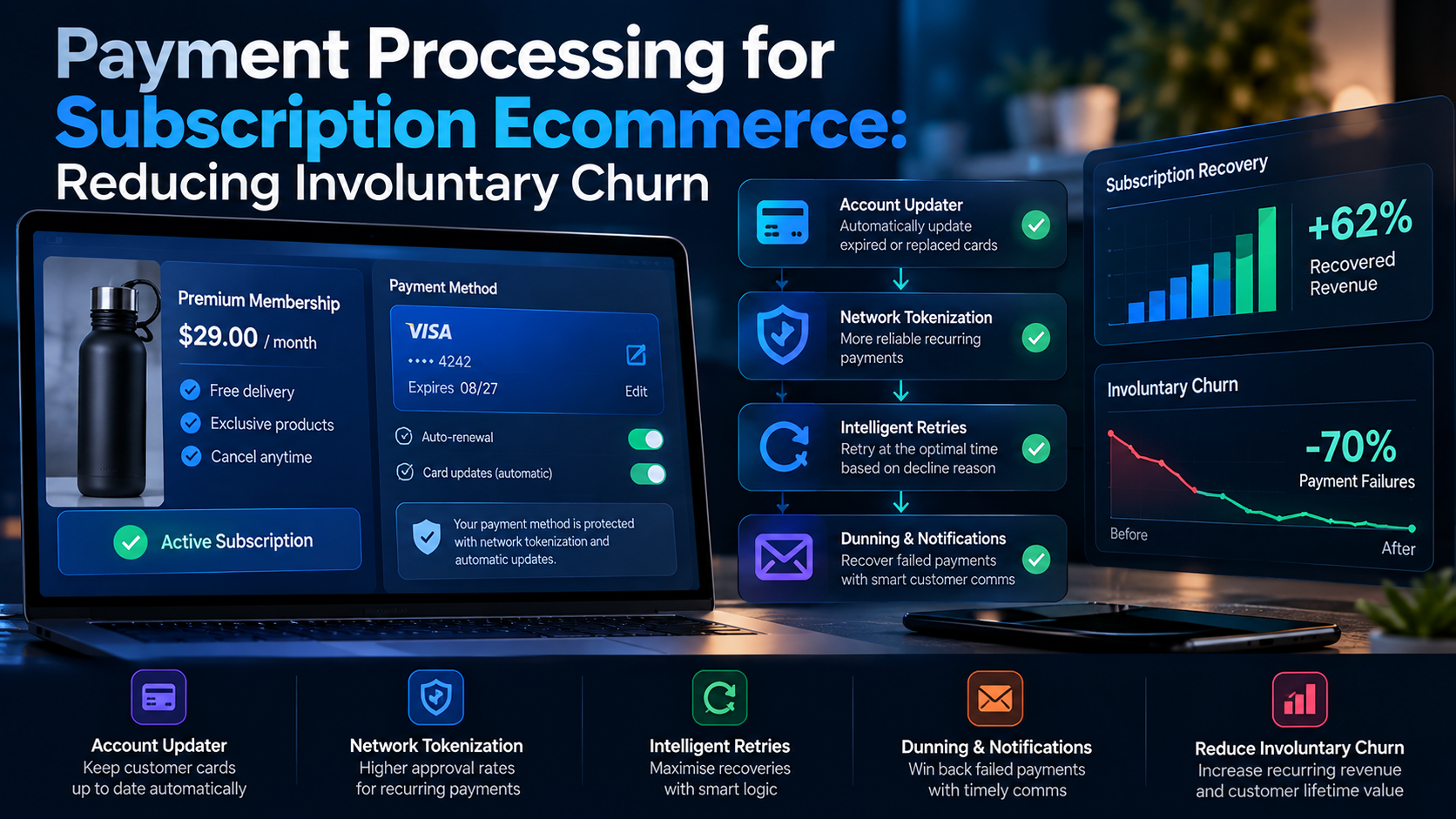
Involuntary churn from failed payments costs subscription businesses 20-40% of revenue. Here is how to fix declined cards, update expired cards, and retain subscribers.
Read More →