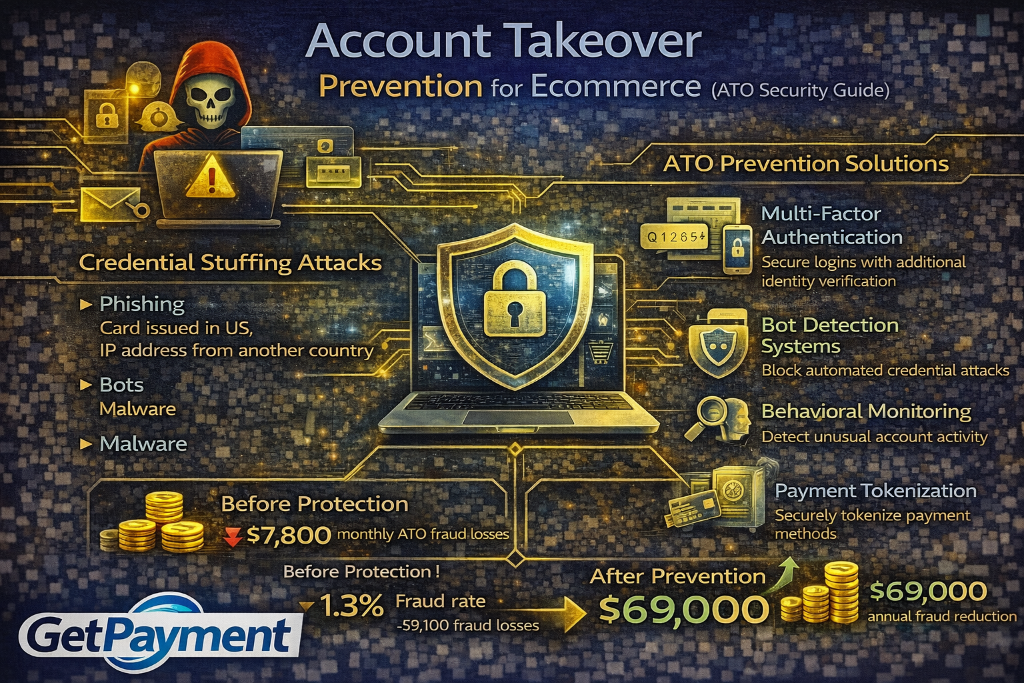
 Learn how ecommerce merchants can prevent account takeover fraud using multi-factor authentication, bot detection, and behavioral monitoring.
Need Payment Processing?
✓ Stripe shutdown?
✓ High-risk industry?
✓ Declined payments?
Get approved today.
Apply NowAccount takeover (ATO) fraud has become one of the fastest-growing threats in ecommerce. Instead of stealing credit card numbers directly, fraudsters increasingly target customer accounts to gain access to stored payment methods, personal data, and loyalty rewards.
Once a fraudster gains control of a customer's account, they can place unauthorized orders, change shipping details, or exploit saved payment credentials. These transactions often appear legitimate because they originate from real customer accounts, making them harder for traditional fraud systems to detect.
For ecommerce merchants, account takeover attacks can lead to chargebacks, customer trust issues, and significant operational losses. As online stores grow and customer databases expand, the risk of ATO attacks increases.
In this guide, we'll explain how account takeover fraud works, why ecommerce businesses are vulnerable, and the strategies merchants can use to protect customer accounts in 2026.
What Account Takeover Fraud Is
Account takeover fraud occurs when an attacker gains unauthorized access to a legitimate customer account.
Fraudsters typically obtain login credentials through methods such as phishing attacks, password leaks, or credential stuffing. Once they gain access to the account, they can perform actions as if they were the real customer.
Common actions in account takeover fraud include:
- placing orders using stored payment methods
- changing account email addresses or passwords
- redirecting shipping addresses
- redeeming loyalty points or gift balances
- accessing personal customer data
Because the attacker is using a real account with valid credentials, these transactions often bypass basic fraud filters.
Why Ecommerce Accounts Are Targeted
Customer accounts contain valuable data that makes them attractive targets for cybercriminals.
Many ecommerce platforms allow customers to save payment methods for faster checkout. These stored cards can be used immediately once an attacker gains access to the account.
In addition to payment information, customer accounts may also contain:
- saved addresses
- phone numbers
- order history
- loyalty program balances
- store credits or gift cards
Attackers can exploit this information to place fraudulent orders or sell compromised accounts on underground marketplaces.
The more successful an ecommerce business becomes, the more attractive its customer database becomes to attackers.
How Account Takeover Attacks Work
Account takeover attacks usually follow a predictable pattern.
First, attackers obtain login credentials through phishing emails, data breaches, or password leaks from other websites.
Next, they attempt automated login attacks against ecommerce sites using credential stuffing tools. These tools test large numbers of username and password combinations across multiple websites.
If a customer has reused the same password across different platforms, the attacker may successfully gain access.
Once inside the account, the attacker can change account settings or immediately place fraudulent orders.
Because the account already has a purchase history, these transactions may initially appear legitimate to fraud detection systems.
Signs of Account Takeover Activity
Merchants can often detect account takeover attempts by monitoring unusual behavior patterns.
Some warning signs include:
- multiple failed login attempts from the same IP address
- login attempts from unusual geographic locations
- sudden password reset requests
- rapid changes to shipping addresses or account details
- multiple high-value purchases within a short time frame
Monitoring these signals helps merchants identify suspicious activity before fraud occurs.
Real-time monitoring systems can automatically flag suspicious login activity and trigger additional authentication steps.
Impact of Account Takeover on Ecommerce Businesses
Account takeover fraud can have serious consequences for ecommerce merchants.
When attackers use stolen accounts to place orders, the legitimate customer may eventually dispute the transaction. This can lead to chargebacks and lost revenue.
Beyond financial losses, account takeover attacks can damage customer trust.
Customers expect online stores to protect their personal information and payment details. If their account is compromised, they may lose confidence in the brand.
High rates of fraud and chargebacks can also lead to increased scrutiny from payment processors and acquiring banks.
For these reasons, preventing account takeover attacks should be a top priority for growing ecommerce businesses.
Key Account Takeover Prevention Strategies
Ecommerce merchants can significantly reduce the risk of account takeover attacks by implementing several protective measures.
Strong Password Policies
Encouraging customers to create strong passwords helps reduce the risk of credential-based attacks.
Merchants can require passwords that include a mix of letters, numbers, and symbols. Some platforms also prevent the use of commonly breached passwords.
Strong password policies reduce the effectiveness of credential stuffing attacks.
Multi-Factor Authentication
Multi-factor authentication (MFA) adds an additional layer of security to customer accounts.
When MFA is enabled, customers must verify their identity using a second authentication factor such as a one-time code sent via SMS, email, or authentication app.
Even if an attacker obtains the password, they cannot access the account without the additional verification step.
Many ecommerce platforms now support optional MFA for customers.
Login Behavior Monitoring
Modern fraud detection systems analyze login behavior to identify suspicious activity.
These systems monitor factors such as:
- device fingerprinting
- IP address reputation
- login location
- typing patterns
If a login attempt appears unusual, the system may trigger additional authentication or block the login attempt entirely.
Behavioral monitoring helps detect account takeover attempts early.
Rate Limiting and Bot Protection
Credential stuffing attacks often rely on automated bots that attempt thousands of login attempts within minutes.
Rate limiting helps prevent these attacks by restricting the number of login attempts from a single IP address.
Bot detection tools can also identify automated login attempts and block suspicious traffic.
These protections make it more difficult for attackers to test large numbers of stolen credentials.
Monitoring Account Changes
Merchants should also monitor important account changes such as password resets, email updates, and shipping address changes.
If these changes occur shortly before a purchase, the transaction may require additional verification.
Monitoring account updates helps detect account takeover attempts before fraudulent purchases are completed.
Example Account Takeover Scenario
Imagine a customer who previously created an account on an ecommerce website and saved their payment information for faster checkout.
The customer reused the same password across several online services.
After a data breach on another platform, attackers obtain the customer's credentials and attempt to log into multiple websites.
Using automated credential stuffing tools, the attacker successfully logs into the ecommerce account.
The attacker quickly changes the shipping address and places an order using the stored payment method.
Without proper account monitoring, this transaction may initially appear legitimate.
However, advanced fraud detection systems can identify suspicious login activity and block the transaction before it is processed.
Common Account Security Mistakes
Many ecommerce merchants unintentionally leave customer accounts vulnerable to takeover attacks.
One common mistake is allowing unlimited login attempts, which makes credential stuffing easier.
Another mistake is failing to implement multi-factor authentication options.
Some merchants also neglect login monitoring systems that can detect unusual behavior patterns.
Finally, merchants sometimes overlook account change monitoring, which allows attackers to modify account details before placing fraudulent orders.
Addressing these weaknesses can significantly improve account security.
Best Practices for Protecting Customer Accounts
Preventing account takeover requires a layered security approach.
Merchants should combine strong password requirements with multi-factor authentication to protect customer accounts.
Login behavior monitoring and bot protection tools help detect suspicious activity before attackers gain access.
Merchants should also educate customers about password security and encourage them to avoid reusing passwords across multiple websites.
Regular security reviews and fraud monitoring help ensure account protection systems remain effective.
By implementing these strategies, ecommerce merchants can significantly reduce the risk of account takeover fraud.
FAQs
What is account takeover fraud?
Account takeover fraud occurs when attackers gain unauthorized access to customer accounts and use them to place fraudulent orders or steal personal data.
How do attackers gain access to ecommerce accounts?
Attackers often use credential stuffing, phishing attacks, or leaked passwords from previous data breaches.
How can merchants prevent account takeover attacks?
Merchants can reduce risk by implementing strong password policies, multi-factor authentication, login monitoring, and bot protection systems.
Why is account takeover difficult to detect?
Because attackers use legitimate customer accounts, fraudulent activity can appear normal unless advanced behavioral monitoring systems are in place.
Conclusion
Account takeover fraud is an increasingly common threat in ecommerce.
As attackers shift from stolen credit cards to compromised customer accounts, merchants must adopt stronger account security strategies.
By implementing multi-factor authentication, monitoring login behavior, limiting automated login attempts, and protecting stored payment credentials, ecommerce merchants can significantly reduce the risk of account takeover attacks.
Protecting customer accounts not only prevents fraud but also strengthens customer trust and protects long-term brand reputation.
Request a Free Payment Fee Audit
If your ecommerce business processes $50k+ monthly, our team can review your payment setup and identify opportunities to improve fraud prevention, reduce chargebacks, and optimize your payment infrastructure.
Tags

Jane Harold
Head of Payment Strategy
GetPayment Inc
Jane Harold is a payment strategy expert with 12+ years of experience in high-volume ecommerce payments, merchant account management, and checkout optimization. She has helped hundreds of US ecommerce brands improve authorization rates, reduce processing costs, and scale payment infrastructure.
Areas of Expertise
Payment Strategy Expert
12+ years in industry
Certified Payment Specialist
PCI DSS Level 1 compliance
Merchant Account Advisor
500+ merchants advised
Industry Speaker
Ecommerce & payment conferences
Get Expert Advice
Have questions about payment processing? Reach out to Jane directly.
Years Experience
Merchants Helped
Bank Partners
Satisfaction Rate
Recover Revenue From Payment Declines
GetPayment helps ecommerce merchants increase approval rates with smart routing and high-risk-friendly processors.
High-risk friendly
Multiple processors
Global coverage
Get Your Free Payment Fee Audit
See exactly how much you're overpaying in processing fees. Our experts analyze your statement and show you potential savings.
Request Free AuditLearn more in our Fraud & Chargeback Prevention Guide
Explore the complete guide for this topic with deeper insights and strategies.
View Guide →Related Articles

GetPayment vs Braintree for Scale: Which Payment Strategy Wins for Growing Ecommerce Businesses?
Compare GetPayment vs Braintree for scaling ecommerce businesses. Learn which solution delivers better approvals, flexibility, and cost optimization.
Read More →
Stripe Alternatives for High Risk Ecommerce (Top 5): Best Payment Solutions for Scaling Businesses
Looking for Stripe alternatives for high-risk ecommerce? Discover the top 5 solutions to improve approvals, reduce risk, and scale your payment system.
Read More →