guides
velocity checks fraud prevention balancereduce false declines ecommercefraud prevention without killing conversionsecommerce fraud optimizationvelocity check calibrationapproval rate optimizationecommerce chargeback prevention
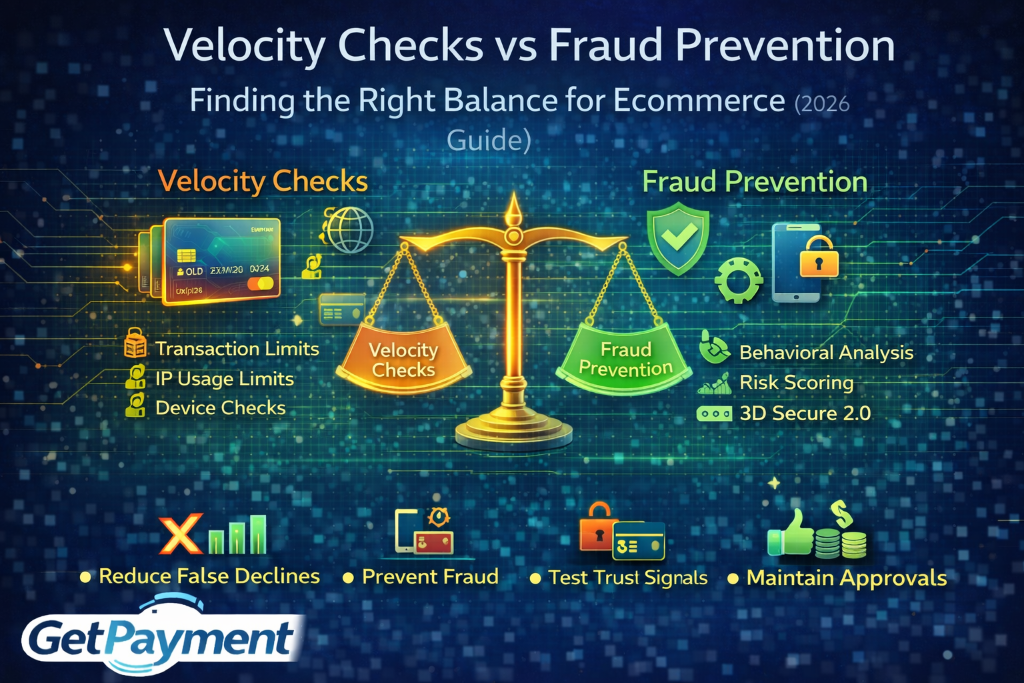 Learn how to balance velocity checks and fraud prevention to reduce chargebacks while maintaining high approval rates and conversions.
✓ Stripe shutdown?
✓ High-risk industry?
✓ Declined payments?
Get approved today.
Apply NowFraud prevention is essential for any ecommerce business.
But there is a point where too much protection starts doing more harm than good.
Many businesses unknowingly block legitimate customers in an effort to stop fraud. The result is lost revenue, lower approval rates, and frustrated buyers.
This is why understanding the balance between velocity checks and fraud prevention is critical. The goal is not just to stop fraud. It is to stop fraud without killing conversions.
Velocity checks are fraud prevention rules that monitor how frequently transactions occur within a certain timeframe.
They are designed to detect suspicious behaviour patterns, such as:
When triggered, velocity checks can block or flag transactions for review.
They are an important tool, but they must be used carefully.
Fraud prevention includes all the systems and rules used to detect and block fraudulent transactions.
This can involve:
These tools help protect businesses from chargebacks and financial loss.
However, they also influence whether legitimate transactions are approved or declined.
Many businesses take a defensive approach and set their fraud filters too strict.
This creates a major issue.
Legitimate customers begin to get blocked.
This leads to:
In many cases, businesses lose more money from false declines than from actual fraud.
A false decline happens when a legitimate transaction is rejected by your fraud system or issuing bank.
These are often caused by:
False declines are one of the biggest hidden revenue leaks in ecommerce.
Velocity checks are powerful, but they are also blunt instruments.
If set too aggressively, they can block normal customer behaviour.
For example:
Without proper tuning, these legitimate actions can look like fraud.
The key is not to remove velocity checks, but to balance them.
To maintain performance while preventing fraud, velocity checks should be carefully calibrated.
You should:
Velocity checks should evolve as your business scales.
Fraud prevention should not operate in isolation.
It must be aligned with your payment performance goals.
This means:
A strong system protects against fraud while still allowing legitimate transactions to go through.
Smart payment routing can help reduce the negative impact of fraud controls.
By routing transactions intelligently, you can:
This creates a more flexible and efficient system.
During high-traffic periods, customer behaviour changes.
More transactions occur in shorter timeframes, which can trigger velocity checks.
If fraud rules are not adjusted, this can lead to:
To avoid this, businesses should:
Peak events require dynamic fraud strategies.
The only way to optimise fraud prevention is through data.
You should regularly analyse:
This data helps you understand where you are losing revenue and where you are exposed to risk.
The goal is to find the balance where fraud is controlled without unnecessarily blocking good customers.
Balancing velocity checks and fraud prevention is especially important for:
These businesses are more exposed to both fraud and false declines.
Many ecommerce businesses make avoidable errors when setting fraud rules.
Common mistakes include:
Fixing these can lead to immediate improvements in revenue.
At GetPayment, we help businesses build payment systems that balance fraud prevention with performance.
We help you:
Our focus is on protecting your business without sacrificing growth.
Fraud prevention is necessary, but it should never come at the cost of your growth.
The most successful ecommerce businesses understand that:
By optimising velocity checks and fraud systems, you can protect your business while still maximising conversions.
If you want to reduce fraud without hurting conversions and improve your payment performance, GetPayment can help.
Apply today to build a payment system that balances risk and revenue for long-term growth.
Tags

Head of Payment Strategy
GetPayment Inc
Jane Harold is a payment strategy expert with 12+ years of experience in high-volume ecommerce payments, merchant account management, and checkout optimization. She has helped hundreds of US ecommerce brands improve authorization rates, reduce processing costs, and scale payment infrastructure.
Payment Strategy Expert
12+ years in industry
Certified Payment Specialist
PCI DSS Level 1 compliance
Merchant Account Advisor
500+ merchants advised
Industry Speaker
Ecommerce & payment conferences
Have questions about payment processing? Reach out to Jane directly.
Years Experience
Merchants Helped
Bank Partners
Satisfaction Rate
GetPayment helps ecommerce merchants increase approval rates with smart routing and high-risk-friendly processors.
High-risk friendly
Multiple processors
Global coverage
See exactly how much you're overpaying in processing fees. Our experts analyze your statement and show you potential savings.
Request Free AuditExplore the complete guide for this topic with deeper insights and strategies.
View Guide →
Compare GetPayment vs Braintree for scaling ecommerce businesses. Learn which solution delivers better approvals, flexibility, and cost optimization.
Read More →
Looking for Stripe alternatives for high-risk ecommerce? Discover the top 5 solutions to improve approvals, reduce risk, and scale your payment system.
Read More →