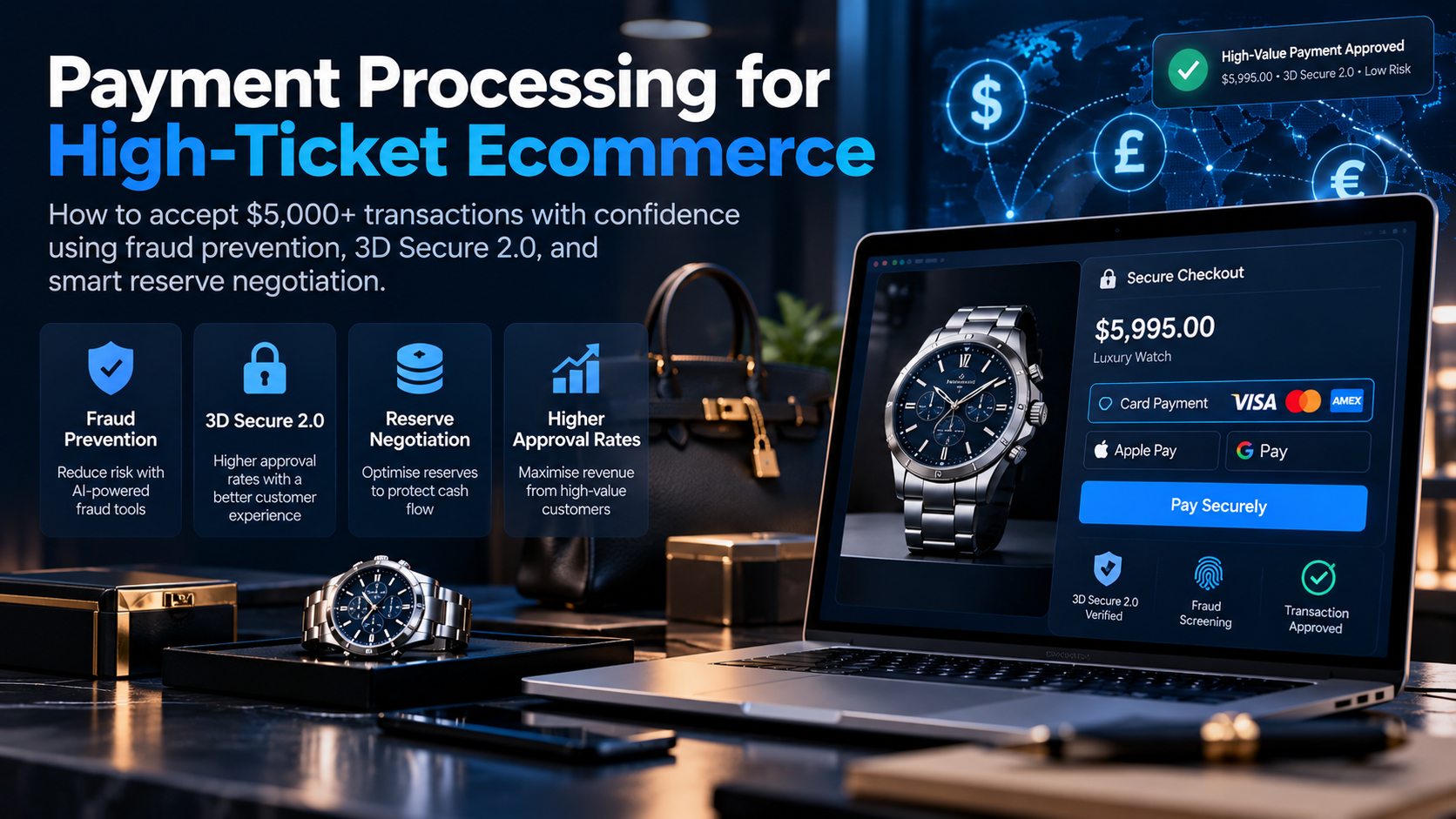
 Payment processing for high-ticket ecommerce: fraud prevention, 3D Secure 2.0, rolling reserves, and multi-acquirer routing for $5,000+ transactions.
Need Payment Processing?
✓ Stripe shutdown?
✓ High-risk industry?
✓ Declined payments?
Get approved today.
Apply NowKey Takeaways
- High-ticket transactions are riskier for processors: A single $10,000 chargeback costs more than 100 $100 chargebacks. Processors respond with tighter limits, higher reserves, and stricter underwriting. - Fraud screening must be calibrated for high tickets: Standard fraud rules flag large transactions as suspicious. You need custom rules and manual review for orders above $2,500. - 3D Secure 2.0 is essential for high-ticket: It shifts liability for fraudulent chargebacks to the card issuer, protecting you on transactions where a single dispute is expensive. - Rolling reserves are common but negotiable: High-ticket merchants often face 5-15% reserves held for 6 months. You can negotiate this down with volume history and clean processing. - Multi-acquirer routing protects against limits: A single acquirer may cap your average ticket or monthly volume. Routing across multiple banks gives you headroom and failover.
High-ticket ecommerce refers to businesses selling expensive products where the average order value (AOV) is significantly above the norm. While there is no strict threshold, most processors consider any business with an AOV above $500 as high-ticket, and AOVs above $2,500 enter a special risk category.
- ✓High-ticket transactions are riskier for processors: A single $10,000 chargeback costs more than 100 $100 chargebacks. Processors respond with tighter limits, higher reserves, and stricter underwriting.
- ✓Fraud screening must be calibrated for high tickets: Standard fraud rules flag large transactions as suspicious. You need custom rules and manual review for orders above $2,500.
- ✓3D Secure 2.0 is essential for high-ticket: It shifts liability for fraudulent chargebacks to the card issuer, protecting you on transactions where a single dispute is expensive.
- ✓Rolling reserves are common but negotiable: High-ticket merchants often face 5-15% reserves held for 6 months. You can negotiate this down with volume history and clean processing.
- ✓Multi-acquirer routing protects against limits: A single acquirer may cap your average ticket or monthly volume. Routing across multiple banks gives you headroom and failover.
TL;DR — Key Takeaways
- High-ticket transactions are riskier for processors: A single $10,000 chargeback costs more than 100 $100 chargebacks. Processors respond with tighter limits, higher reserves, and stricter underwriting.
- Fraud screening must be calibrated for high tickets: Standard fraud rules flag large transactions as suspicious. You need custom rules and manual review for orders above $2,500.
- 3D Secure 2.0 is essential for high-ticket: It shifts liability for fraudulent chargebacks to the card issuer, protecting you on transactions where a single dispute is expensive.
- Rolling reserves are common but negotiable: High-ticket merchants often face 5-15% reserves held for 6 months. You can negotiate this down with volume history and clean processing.
- Multi-acquirer routing protects against limits: A single acquirer may cap your average ticket or monthly volume. Routing across multiple banks gives you headroom and failover.
What Counts as High-Ticket Ecommerce?
High-ticket ecommerce refers to businesses selling expensive products where the average order value (AOV) is significantly above the norm. While there is no strict threshold, most processors consider any business with an AOV above $500 as high-ticket, and AOVs above $2,500 enter a special risk category.
Common high-ticket categories:
- Furniture and home goods ($1,000 to $10,000 AOV)
- Electronics and computers ($1,500 to $5,000 AOV)
- Luxury goods and jewelry ($2,000 to $50,000 AOV)
- B2B equipment and industrial supplies ($2,000 to $100,000 AOV)
- Travel packages and experiences ($1,000 to $10,000 AOV)
- Fitness equipment and home gyms ($1,000 to $5,000 AOV)
- Art and collectibles ($1,000 to $100,000 AOV)
Why High-Ticket Is Different
Risk Concentration
A standard ecommerce store processing $100,000/month at $50 AOV has 2,000 transactions. If 1% charge back, that is 20 chargebacks at $50 each — $1,000 in chargeback costs.
A high-ticket store processing $100,000/month at $2,500 AOV has 40 transactions. If 1% charge back, that is less than one chargeback — but it costs $2,500 plus a $25 chargeback fee. One fraudster who successfully disputes a $10,000 order wipes out the profit on dozens of legitimate sales.
Processor Limits
Acquiring banks impose limits on average ticket size and monthly volume to manage their risk exposure. A processor may approve you for $100,000/month at $100 AOV but reject the same volume at $3,000 AOV. High-ticket merchants need processors with established high-ticket acquiring relationships.
Underwriting Scrutiny
High-ticket merchants face more thorough underwriting because the risk per transaction is higher. Expect to provide:
- 3-6 months of processing statements (if you have prior history)
- Bank statements showing cash flow
- Business licenses and registrations
- Product catalogs and pricing
- Refund and return policies
- Fulfillment timelines (longer delivery = higher chargeback risk)
Strategy 1: Choose a High-Ticket-Friendly Processor
Not all processors handle high-ticket well. Look for:
- Established relationships with multiple acquiring banks that accept high-ticket merchants
- Experience with your product category
- No hard cap on average ticket size (or a cap well above your AOV)
- Custom reserve negotiation rather than blanket policies
- Chargeback protection tools included (Ethoca, Verifi, order validation)
Red flags:
- "We can approve anyone" (they will place you with a bank that will shut you down)
- Mandatory 15%+ rolling reserve with no negotiation
- Volume caps below your projected monthly processing
- No experience with your industry
Strategy 2: Implement Layered Fraud Prevention
High-ticket fraud is more sophisticated and more costly. Your fraud prevention needs to be layered:
Layer 1: Automated rules (catch obvious fraud)
- AVS (Address Verification Service) mismatch
- CVV mismatch
- Velocity checks (multiple orders from same IP or card)
- BIN filtering (block high-risk card issuers or countries)
- Device fingerprinting
Layer 2: Risk scoring (catch subtle fraud)
- Behavioral analysis (typing speed, mouse movements, navigation patterns)
- Email age and reputation
- Shipping/billing address mismatch
- Order velocity compared to customer history
- Proxy and VPN detection
Layer 3: Manual review (catch edge cases)
- Review all orders above $2,500
- Review first-time customers with high-ticket orders
- Review orders with expedited shipping to addresses different from billing
- Review orders from high-risk countries
Layer 4: Liability shift (protect against fraud chargebacks)
- Enable 3D Secure 2.0 on all high-ticket transactions
- Use processor-provided chargeback protection (Ethoca alerts, Verifi CCRN)
- Require signature on delivery for orders above $1,000
Strategy 3: Use 3D Secure 2.0 Strategically
3D Secure 2.0 (3DS2) shifts liability for fraudulent chargebacks from you to the card issuer. For high-ticket merchants, this is essential — a single $5,000 fraud chargeback is painful, and 3DS2 prevents it from being your cost.
Implementation tips:
- Enable 3DS2 on all transactions above $500 (or your risk threshold)
- Use frictionless flow when possible (most 3DS2 authentications are invisible to the customer)
- Monitor your 3DS2 authentication rate — target 80%+ of high-ticket transactions
- Track the liability shift percentage — this is the share of transactions where fraud liability moved to the issuer
Impact: Properly implemented 3DS2 can reduce fraud chargebacks by 60-80% on high-ticket transactions with minimal conversion impact (typically under 2%).
Strategy 4: Manage Rolling Reserves
A rolling reserve is a percentage of your processing volume held by the processor for 6 months to cover potential chargebacks. For high-ticket merchants, reserves of 5-15% are common.
How to negotiate a better reserve:
- Provide 6+ months of clean processing history (low chargeback rate, no fraud issues)
- Show strong refund and return policies
- Demonstrate fraud prevention tools in place
- Offer to start at a higher reserve that reduces after 3-6 months of clean processing
- Process with multiple acquirers to spread risk
Reserve release: Reserves are typically released 6 months after the held funds. Make sure you understand the release schedule before signing.
Strategy 5: Multi-Acquirer Routing
A single acquirer may cap your average ticket or monthly volume. Multi-acquirer routing sends transactions to different banks based on:
- Transaction size (route very large tickets to banks with higher limits)
- Risk level (route higher-risk transactions to banks with better chargeback tolerance)
- Cost (route to the cheapest bank for each transaction type)
- Failover (if one bank is down, route to another)
Impact: Multi-acquirer routing gives you headroom to grow without hitting volume caps, and protects against a single bank outage taking you offline.
Strategy 6: Optimize for Chargeback Prevention
High-ticket chargebacks are expensive and can quickly push you over processor thresholds. Focus on prevention:
Pre-transaction:
- Clear product descriptions and images (reduce "not as described" disputes)
- Explicit shipping timelines (reduce "non-receipt" disputes)
- Require signature on delivery for high-value orders
- Send order confirmation and shipping notifications
Post-transaction:
- Respond to chargebacks within the time limit with compelling evidence
- Use chargeback alert services (Ethoca, Verifi) to refund before a chargeback is filed
- Track chargeback reason codes and address root causes
- Maintain a chargeback log with resolution outcomes
Strategy 7: Offer Financing and Payment Plans
High-ticket prices create checkout friction. Offering financing increases conversion and average order value:
- Buy now, pay later (BNPL) for orders $500 to $10,000
- Installment payments for subscriptions or memberships
- Net-30 or Net-60 terms for B2B customers
- Lease-to-own for equipment
Impact: Adding BNPL to a high-ticket checkout can increase conversion by 20-30% and AOV by 15-25%.
Measuring High-Ticket Payment Health
Track these metrics:
- Authorization rate: Target 90%+ (high-ticket declines are costly)
- Chargeback rate: Target under 0.75% (processor thresholds are tighter for high-ticket)
- Fraud rate: Target under 0.1% of transaction value
- 3DS2 coverage: Target 80%+ of high-ticket transactions
- Reserve impact: Track cash flow impact of held reserves
The Bottom Line
High-ticket ecommerce is profitable but requires specialized payment processing. The right processor, layered fraud prevention, 3D Secure 2.0, and multi-acquirer routing let you accept large transactions without excessive risk or reserves.
Next Steps
- Calculate your true AOV and identify your risk category
- Ask your processor about high-ticket limits and reserve policies
- Enable 3D Secure 2.0 on transactions above $500
- Implement manual review for orders above $2,500
- Add BNPL or financing options to your checkout
Tags

Jane Harold
Head of Payment Strategy
GetPayment Inc
Jane Harold is a payment strategy expert with 12+ years of experience in high-volume ecommerce payments, merchant account management, and checkout optimization. She has helped hundreds of US ecommerce brands improve authorization rates, reduce processing costs, and scale payment infrastructure.
Areas of Expertise
Payment Strategy Expert
12+ years in industry
Certified Payment Specialist
PCI DSS Level 1 compliance
Merchant Account Advisor
500+ merchants advised
Industry Speaker
Ecommerce & payment conferences
Get Expert Advice
Have questions about payment processing? Reach out to Jane directly.
Years Experience
Merchants Helped
Bank Partners
Satisfaction Rate
Recover Revenue From Payment Declines
GetPayment helps ecommerce merchants increase approval rates with smart routing and high-risk-friendly processors.
High-risk friendly
Multiple processors
Global coverage
Get Your Free Payment Fee Audit
See exactly how much you're overpaying in processing fees. Our experts analyze your statement and show you potential savings.
Request Free AuditRelated Articles
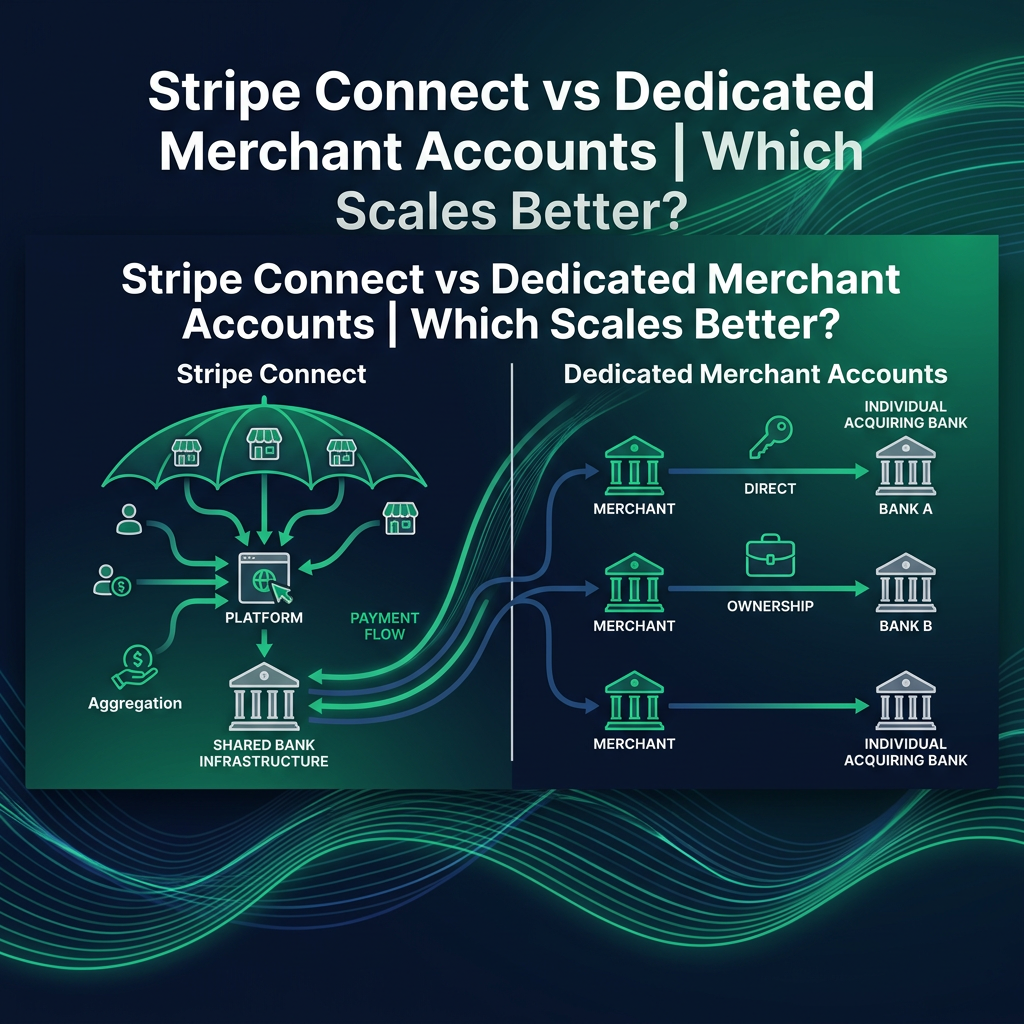
Stripe Connect vs Dedicated Merchant Accounts: What Scalable Ecommerce and Platforms Should Choose
Compare Stripe Connect vs dedicated merchant accounts to understand which payment model offers better scalability, control, and stability for growing platforms and ecommerce businesses.
Read More →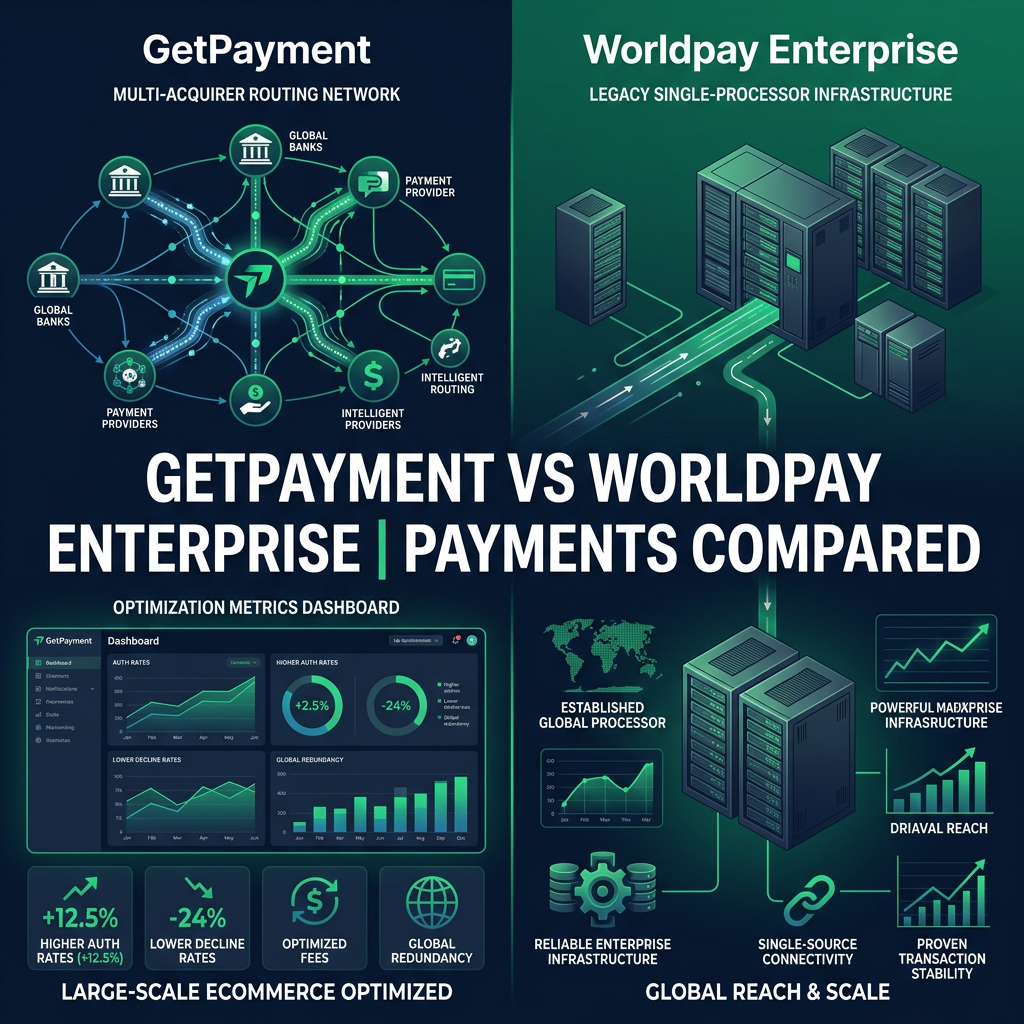
GetPayment vs Worldpay Enterprise: Which Payment Strategy Is Better for Large-Scale Ecommerce?
Compare GetPayment vs Worldpay Enterprise for large-scale ecommerce. Learn which solution delivers better approvals, lower costs, and scalability for high-volume merchants.
Read More →